Storm damage restoration in Ventura County means getting the water and mud out, opening whatever will not dry on its own, drying the structure on meter readings instead of guesswork, and then building the rooms back, from Oxnard to Ojai. Residential and commercial, English and Spanish on the crew, and (805) 427-9039 reaches a dispatcher who starts with the burn scar above you.
On burned ground it takes about a quarter of an hour.
Fire bakes a waxy layer into the topsoil and the hillside stops drinking. For years afterward rain slides off that slope instead of soaking in, picking up ash, grit, rock, and brush on the way down to you.
The federal thresholds are specific enough to plan around. On the Mountain Fire scar, 0.42 inches of rain inside fifteen minutes gives a fifty-fifty chance of a debris flow, and 0.55 inches raises it to three chances in four. The newer scar is worse. The Sandy Fire burned 2,183 acres off Sandy Avenue beside Simi Valley in 2026, took nine days to contain, and enters this rainy season with a coin-flip trigger of 0.329 inches in fifteen minutes. One brief cell overhead, not a named storm.
And what arrives is not really mud. Half of it or more is sand-sized or larger, it carries boulders and fence posts and pieces of somebody’s deck, and it usually moves between ten and thirty miles an hour. That is why a flow takes a wall out instead of staining it, and why the cleanup looks like excavation.
The opening hour goes on stopping the loss from spreading and recording the scene before a shovel moves.
Power comes off at the panel for every circuit the water reached. Then photographs: wide from each doorway, close on the line the flow left across the baseboard, the water heater stand, the garage wall. That line is the only evidence of how deep it ran, and it vanishes the moment cleanup starts.
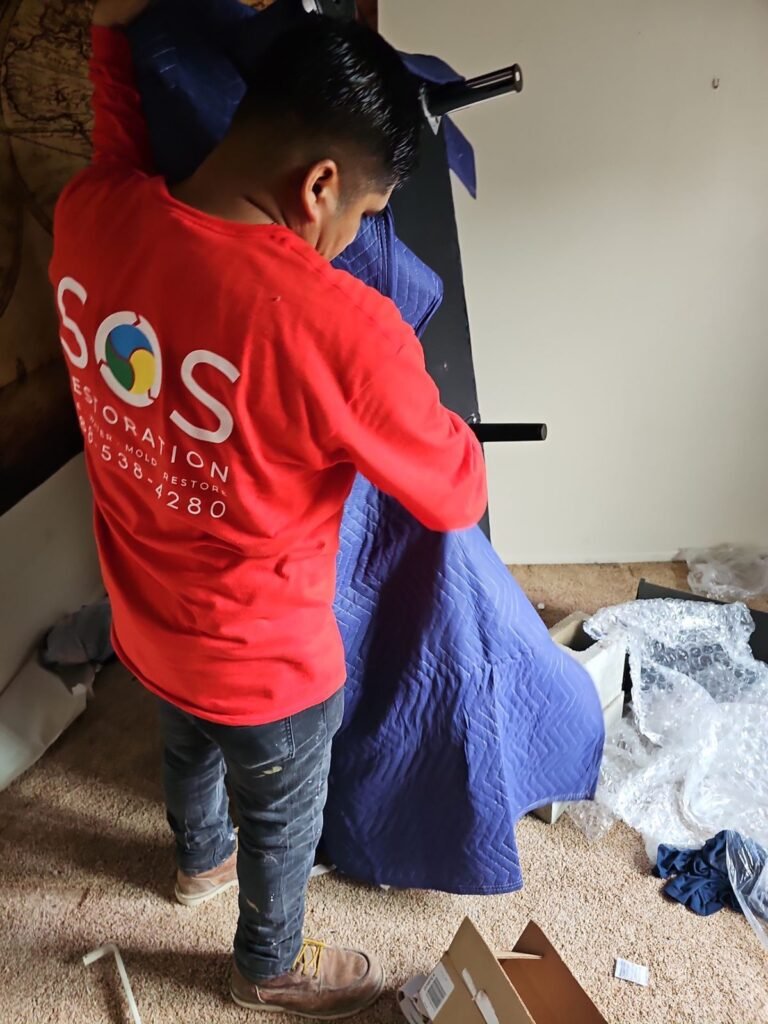
Belongings come out in order of what cannot be replaced: papers, medication, drives, the boxes on a closet floor. Furniture gets blocked up off wet flooring. Every porous thing that sat in the flow is photographed as it goes onto the pile, because an inventory written from memory a week later convinces nobody.
Before you decide anything, get the walls read. The technician on site arrives with a meter, works the rooms and marks which walls are genuinely wet behind paint that looks fine. That visit carries no bill and no signature. On a storm night that is the difference between two rooms and a whole floor.
Water leaves first, by extraction, because nobody can work a floor they cannot see.
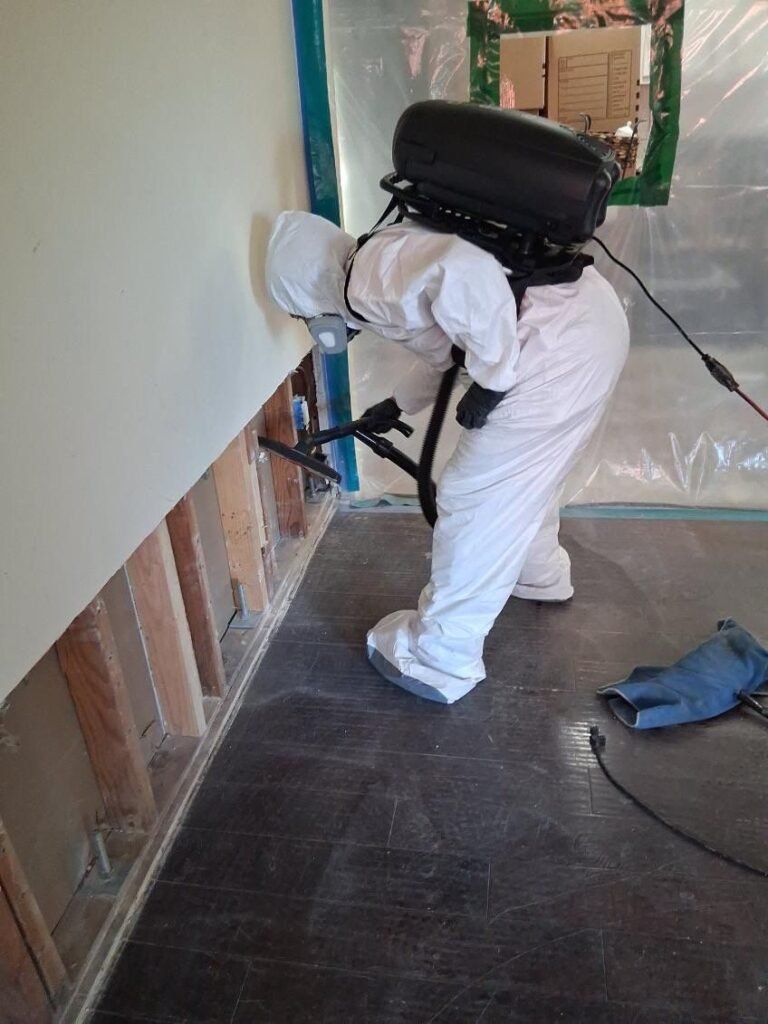
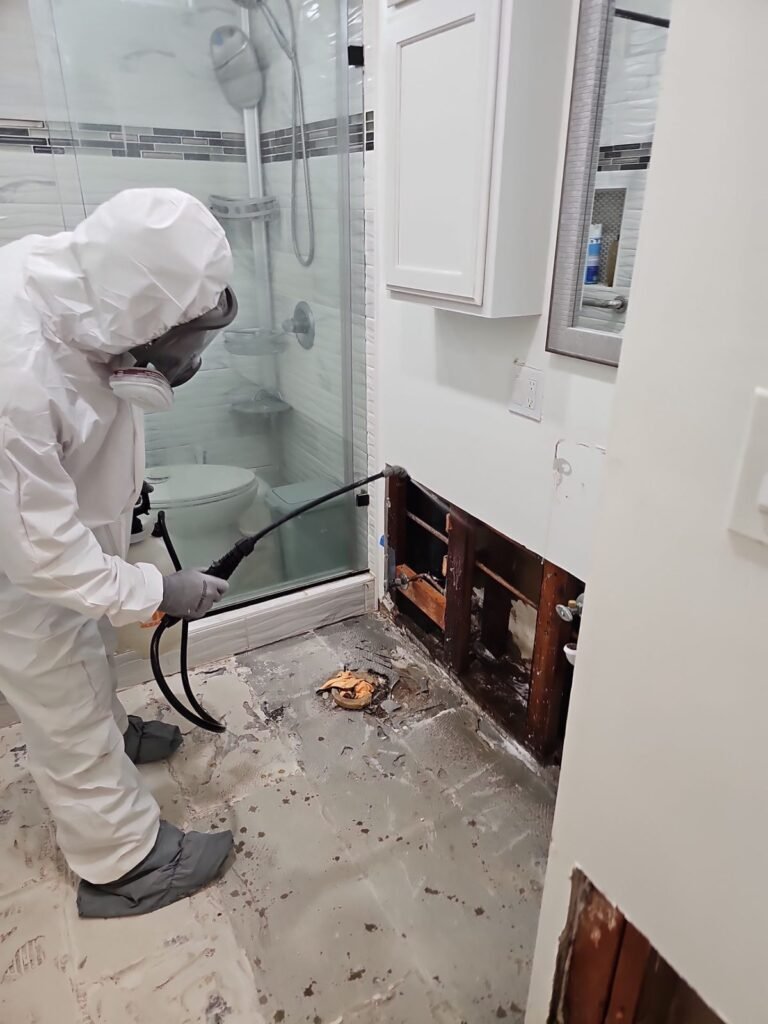
Mud goes by hand into wheelbarrows, then the film on the slab comes off with pressure and is pulled straight back up wet. Carpet, pad, laminate, and vinyl plank leave the building. Solid wood gets metered before anyone condemns it.
Runoff off a burn scar or out of a channel is not clean water and is not handled as though it were. Across two days of the 2023 storms the Ojai Valley Sanitary District reported 5.4 million gallons of sewage released and then 5.6 million more, eleven million gallons inside forty-eight hours, bound for surface water and the beach. That same year a pipe failure on C Street in Fillmore sent 109,985 gallons into a storm drain. Whatever came under your door came out of that same weather.
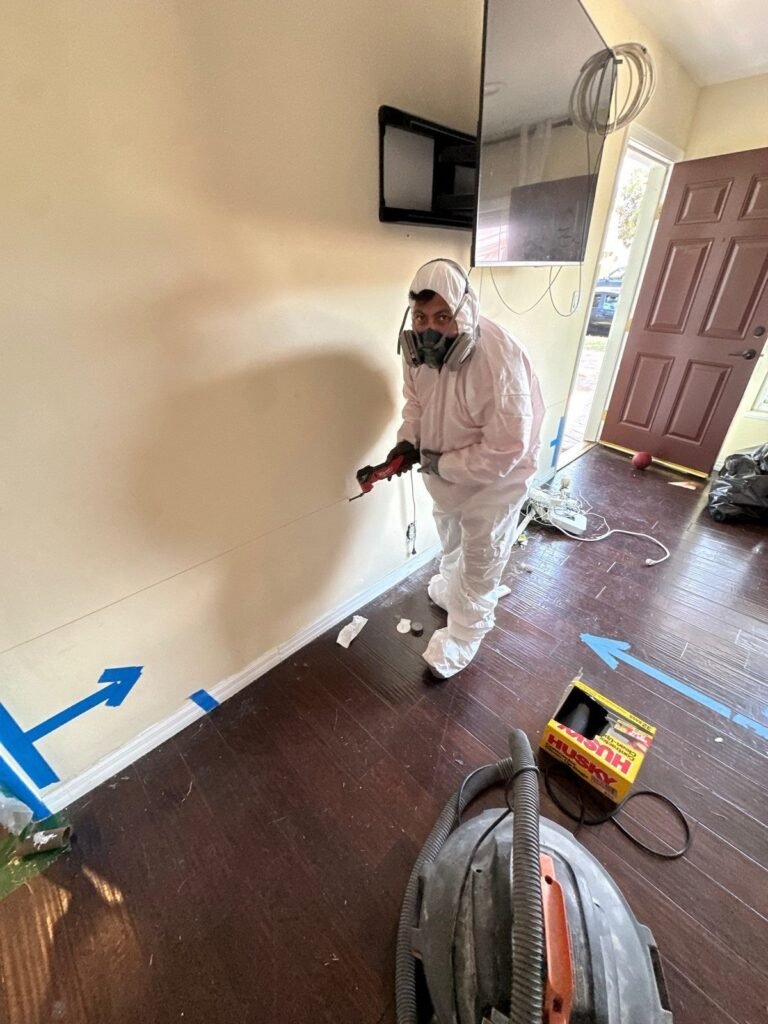
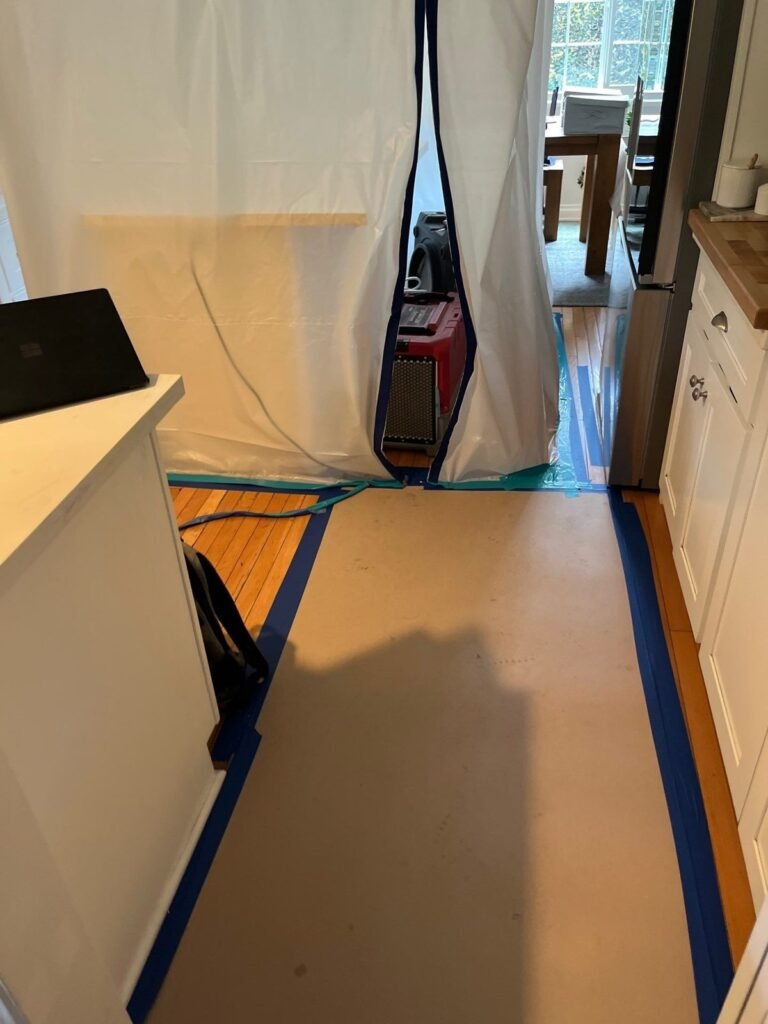
So: gloves, boots, containment on the doorways, the heating and air off so the blower is not spreading it, and anything the flow soaked through taken out rather than dried and hoped over.
By reading it every day, in the same marked spots, and writing the number down with a date beside it.
Paint gives up its moisture within a day and looks finished from the couch while the gypsum core, the bottom plate, and the batt behind them are still loaded.
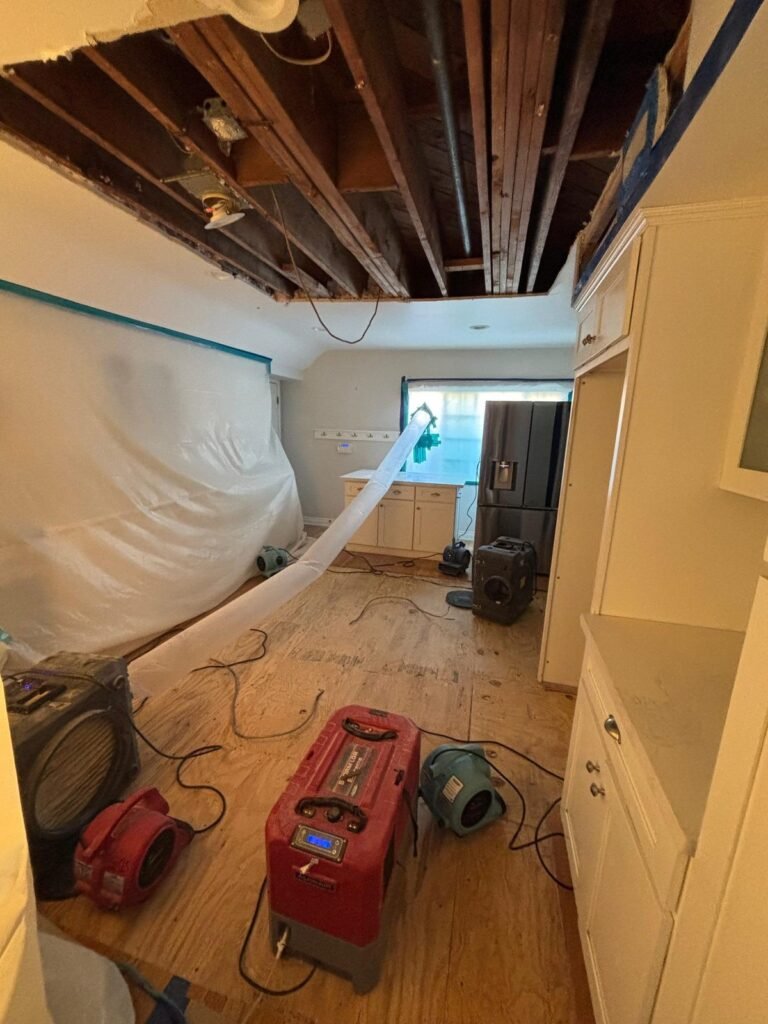
Three instruments settle the argument. A pin meter, whose probes press in and read how wet the material is at depth. A pinless meter that scans a finished surface without marking it. And a hygrometer on the room air, because a dehumidifier that is not pulling grains of water out of that air is a heater with a fan on it.
The target is never zero. It is a dry standard taken off the same material somewhere the storm never reached, so the wet side of the house is judged against the building’s own baseline, not a figure out of a book. Air movers run along the wet surfaces, a dehumidifier sized to the volume sits beside them, and either the numbers fall daily or the setup changes. How long that runs depends on the structure: open framing in a dry week is one thing, lath and plaster over a soaked stud bay in an Ojai bungalow is another.
Because the ground that failed sits uphill of you, and it stays dangerous long after the smoke clears.
Federal geologists have run emergency debris-flow assessments on eight fires touching Ventura County over the past decade: Solimar, Thomas, Woolsey, Hill, Maria, Mountain, Kenneth, and Sandy. Out here that is routine paperwork, not a rarity.
The local record makes the timing plain. The Springs Fire burned above Camarillo in 2013. Nineteen months later a wall of mud and debris severely damaged ten homes in Camarillo Springs, in places right up to the roofline. Six weeks before that, forecasters had logged nothing worse than moderate showers on the same scar, and those showers trapped a man waist-deep on San Como Lane.
The Solimar Fire ends the idea that a small burn means a small problem. It covered 1,388 acres, and its scar shut lanes of the 101 four separate times across fourteen months. On the Thomas scar the following spring, flows crossed Highway 150 near Steckel Park and the 101 near Mussel Shoals, on rainfall the weather service recorded as over the published thresholds. In 2026 a storm delivering two to five inches sent debris across every lane of the 101 at La Conchita.
From 2014 through 2026 the national storm database logs 58 flood and debris-flow events here, eleven naming a burn scar, and federal guidance is to expect raised flood risk for five years after a fire. The county in one detail: in 2024 crews logged flash flooding and debris flows on Balcom Canyon Road. The Mountain Fire started its run on that same stretch of asphalt nine months afterward.
Because a flood map prices risk. It does not fence it off.
Of the 1,331 flood insurance claims ever paid in this county, 535 sat on properties mapped outside the high-risk area. Two in five, against roughly one in five nationally.
The shape of it changes city by city. Oxnard’s exposure is mostly ocean rather than river: 1,503 acres in the coastal velocity zone against 838 acres of ordinary high-risk ground, plus 5,723 acres, 22.6 percent of the city, inside the 500-year band where no lender obliges anybody to carry coverage. Inland it is the rivers. The Santa Clara drains 1,596 square miles and once ran 165,000 cubic feet per second past Montalvo; in a single day of the 2005 floods Sespe Creek hit 85,300 near Fillmore, and Santa Paula Creek 27,500 off only 38.4 square miles.
Two general points before the next front, neither one advice about your own paperwork. Flood coverage answers for mudflow, the moving kind, and not for a landslide or a slope that simply let go. And a new flood policy generally needs thirty days to take effect, so buying one while the forecast is on television buys nothing. Your own coverage is a question for the agent who sold it.
Wet insulation will not dry inside a closed cavity, so the wall opens where the meter draws the line.
It holds water against the framing and hands it back for weeks, and the line the meter draws is rarely where the staining ends.
Age changes the order rather than the method: in an older house nothing gets cut until a sample comes back, and the testing that runs before any demolition covers why that wait is not optional.
The emergency and drying half runs hourly. The rebuild is one written figure, and that is law rather than preference.
Storm work begins at $90 an hour, and where the total lands follows the job: how many rooms went under, the hours a ceiling sat loaded before anybody noticed, whether the attic has to be stripped, and how much equipment the volume swallows. The visit and the readings are free, and the hourly breakdown lives on our restoration cost page.
The rebuild works the opposite way. California will not let a rebuild be sold by the hour: the price goes into the contract whole, in dollars, before the work starts. Framing, insulation, drywall, texture, paint, trim, cabinets, and flooring reach you as one figure signed before anybody unloads a tool, never as a meter ticking in your living room. What moves that figure is set out on our rebuild page.
One right to know before you sign with anybody this winter. Where an emergency has been declared for the event, a contract to repair a damaged home carries a seven business day right to cancel, and that declaration need not come from the Governor or the President; a local emergency declared by your city or county triggers it alone. In a declared disaster area a court must also impose the maximum penalty on a contractor who breaks those rules. Our numbers are CSLB #1131134 for construction and IICRC #70194273 for mitigation, both worth checking before you let anyone in. Hours and the form sit on the contact page.
Our last day is the day the room works again, and you keep the folder that proves how it got there.
The same crew that carried the wet material out puts back framing, insulation, board, texture, paint, trim, cabinets and floor, and the case folder goes with them: photographs shot before anything moved, every reading with its date, and an itemized account of what left the building and why. Keep it. It answers the smell that turns up in the first hot week and the buyer’s inspector three years out.
But every line in that folder is a measurement, and a measurement is not a ruling. Turning one into the other happens off your property, in hands that were never on the job. Your insurance company settles the money from what we recorded, so our end is a record too specific to wave off. Where a flow has shoved a footing, an engineer draws and seals the repair, and that drawing governs the framing. The card at the end gets signed at the permit counter, which leaves us building work that passes and standing there while it is walked.
That division is the reason the folder gets put together the way it does: strangers read it later, with nobody from this company in the room to explain it. Storm work stays with us from the first hose to the last coat of paint, at (805) 427-9039, and the rest of what we run county-wide is on our Ventura County home page.
A wet week shows up differently depending on the ground under you: runoff off a burn scar in one town, a river coming up in another, a roof giving way on the coast. All of it is the same phone call.

Your phone number is the only thing we really need. Everything else just helps us send the right crew with the right equipment.
Mud sets like concrete once it dries in place, which is why this call is worth making before it does. Dial (805) 427-9039 and tell our dispatcher which Ventura County hillside is above you.