Fire and smoke damage restoration in Ventura County, in the order the work has to happen

SOS Restoration of Ventura County handles fire and smoke damage from the first night on: securing whatever is open to the sky, drying what the hoses soaked, hauling out the material holding the smell, cleaning the soot off everything left standing, and rebuilding the rooms afterward, from Oxnard to Ojai. Call (805) 427-9039 at any hour.

What do you do first, before anybody cleans anything?

The building gets closed up and the utilities stay dead.

That is the first move on every fire loss, before a sponge touches a wall.

Nobody walks in ahead of the fire department, our crews included. Once the scene is handed back, whatever is open to the street or the sky gets boarded and tarped that same visit. Rain and strangers are the second loss, and both arrive through the hole the first one left. Gas and electricity come back only when the utility, or an electrician, says so.

Then the pictures, before a single object shifts. Room by room, closets and drawers open, burned rooms shot from the doorway. That set is the only untouched version of your house that will ever exist, and the whole claim leans on it.

The look is free. The technician on site walks the building, puts meters on the framing and says out loud which rooms are wet, which are contaminated and which are only dirty. You get that reading and a straight answer, with no bill behind it and no decision owed at the door. Crews work in Spanish and English, which matters at the hour when somebody is trying to describe a smell in a second language.

In what order does the rest of the work go?

Water first, then containment, then removal, then dry cleaning, then wet cleaning, then sealing, then construction.

Jumping around inside that list is why so many houses get cleaned twice.

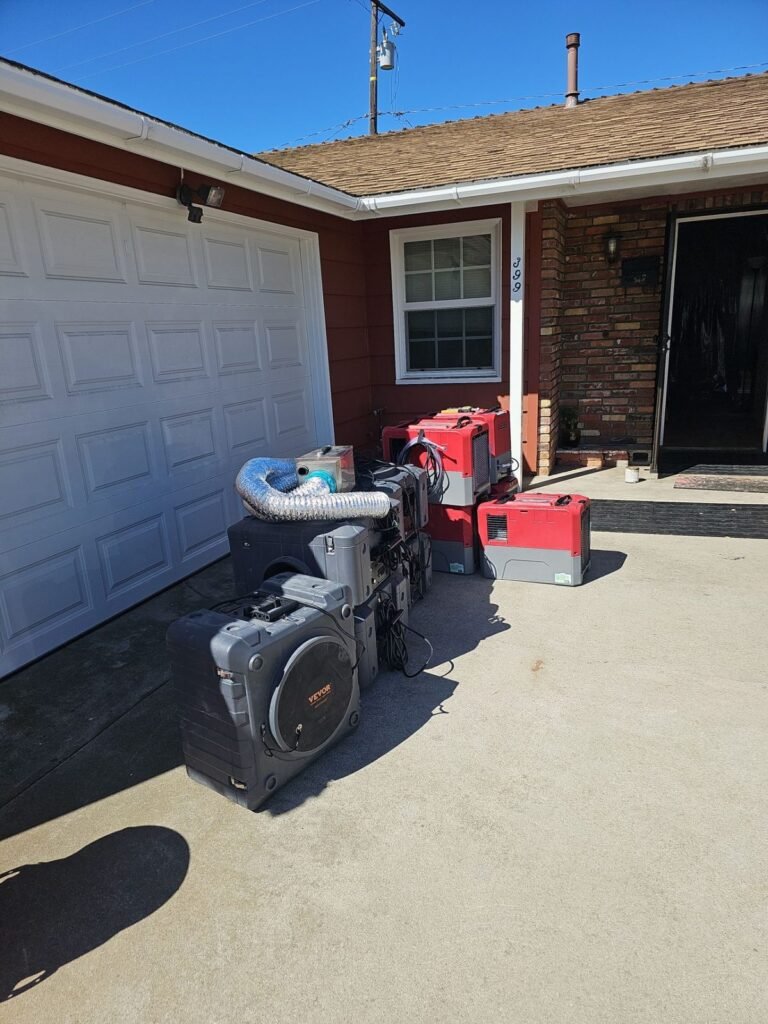
Fire hoses put a startling volume of water into rooms that never saw a flame, and sprinklers do the same in a commercial building. So the soaked half gets worked like any water loss: readings room by room, sodden pad and insulation carried out, drywall cut above the line the water climbed, machines running until framing and subfloor hold a steady number several mornings together. A structure standing open under a hole in the roof looks like it is drying itself. It is not.

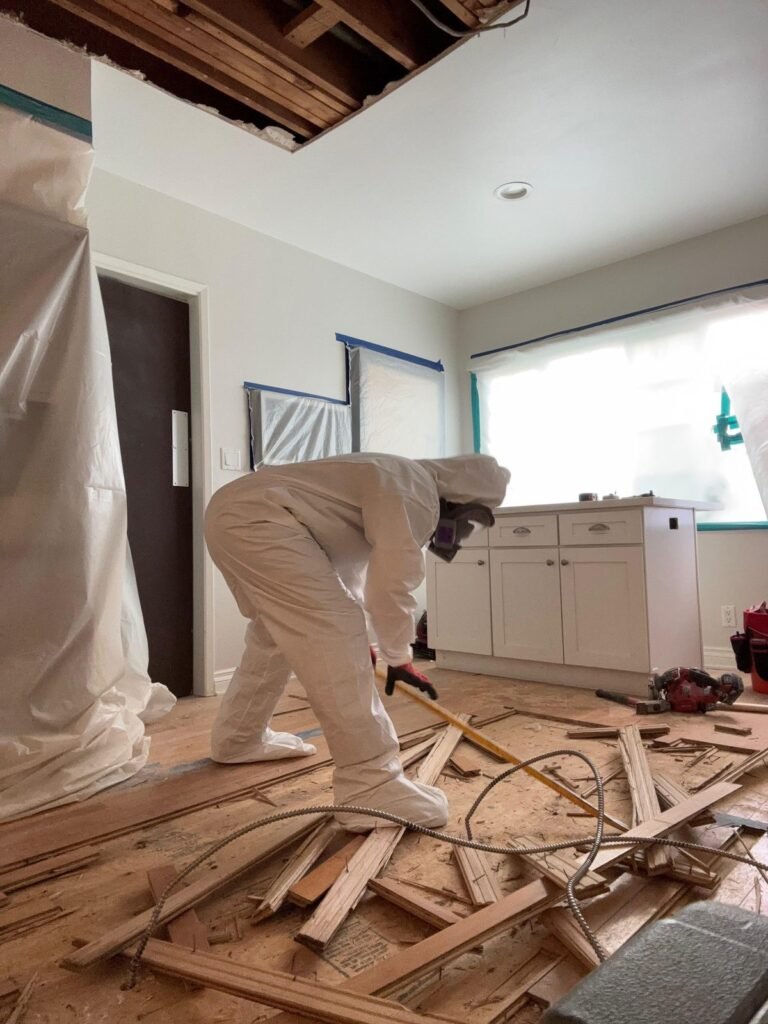
Plastic sheeting goes up next. A filtered machine pulls the sealed rooms down below the pressure of everything around them and blows outdoors, which is what keeps soot from wandering into the rooms that escaped. Then removal: carpet pad, smoke-loaded insulation, charred sheathing, cabinets whose particleboard drank the smell along every cut edge. On an older house none of that comes down until a sample names the material, which what gets tested first explains. Whatever is left standing gets a dry pass before a drop of liquid touches it, because moisture drives soot into paint and grout and fixes it there for good. Vacuums filtered finely enough to hold the particle rather than exhaust it, then dry rubber sponges turned to a clean face as they load.

Only afterward does anything wet come out, and the chemistry follows the fuel. A protein fire off a forgotten pan leaves a thin varnish you can barely see and cannot stop smelling. Burned plastics and wiring leave an acidic film eating the finish underneath while everybody is still arguing about the sofa, so that surface goes first. Sealing sits second to last, never as a substitute for the steps above it.

What do you measure, and what do those numbers actually mean?

Moisture in the materials, moisture in the air, and the gap between the two, logged by date and by room.

Readings are what turn “it feels dry in here” into something an insurance company can act on.

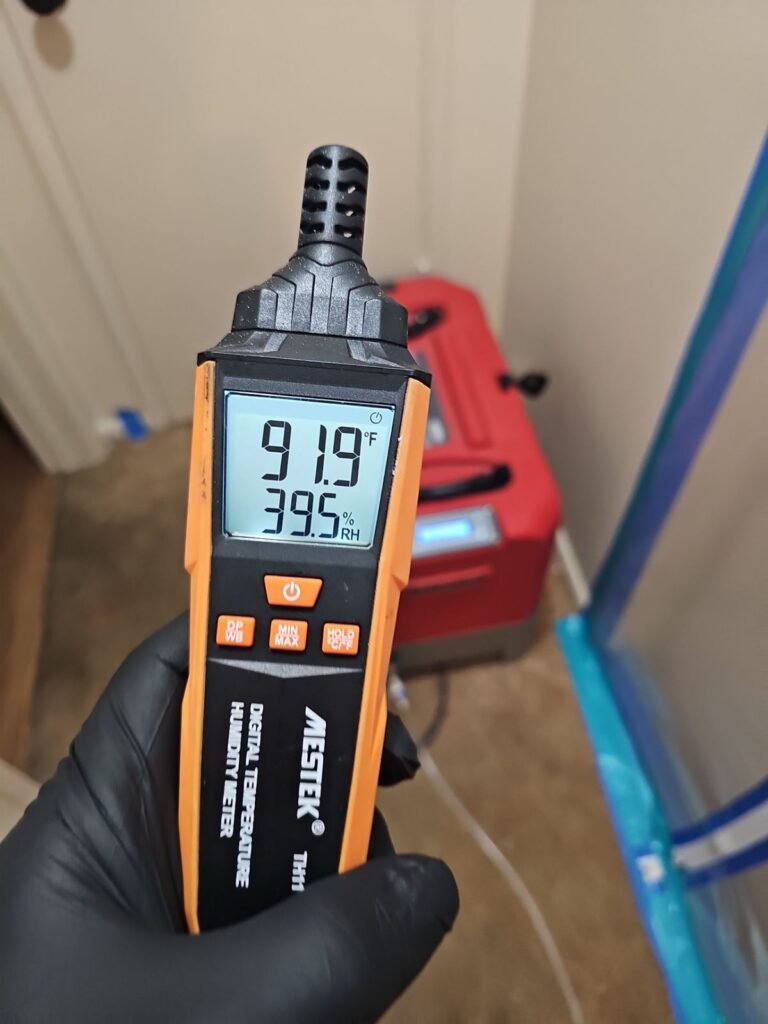
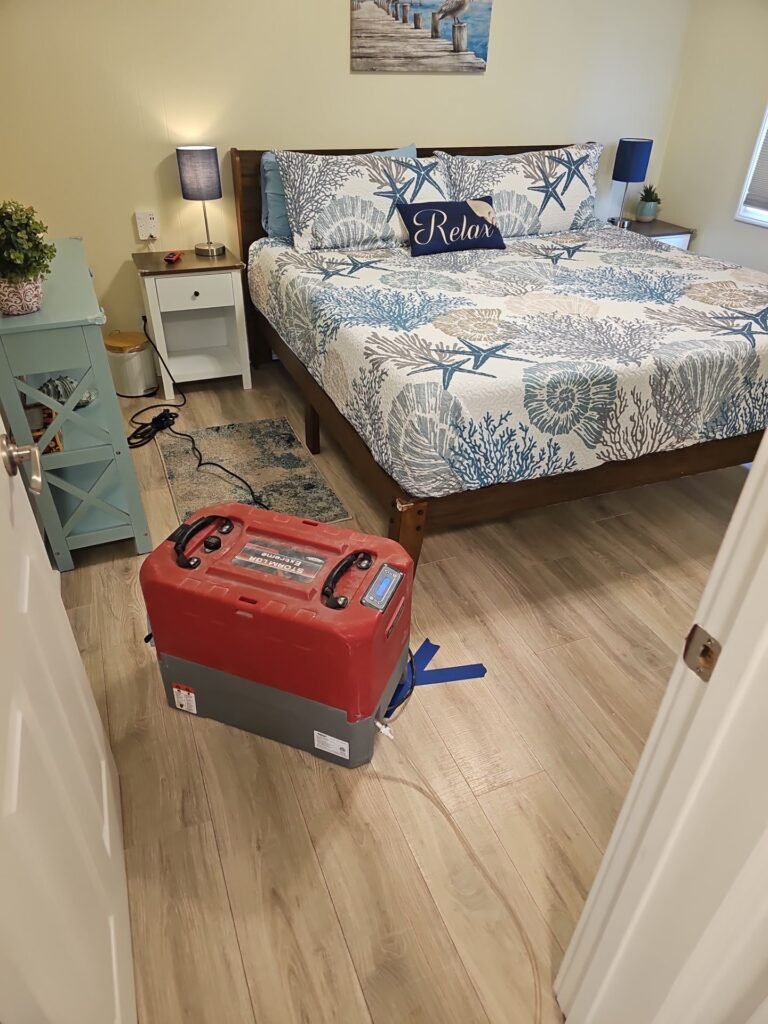
A pinless meter scans framing and subfloor without leaving holes; pins go in where a reading has to be certain. A thermo-hygrometer reads the air going into a dehumidifier and the air coming out, and the difference tells you whether the machine is still pulling water or merely warming the room. A closet on the dry side of the building sets the benchmark: once the wet rooms read what that closet reads and stay there several days running, the structure is dry.

Thermal imaging points, it does not prove. A camera shows a cold patch on a ceiling; a meter tells you whether that patch is water or a gap in the insulation.

On the smoke side the measuring is cruder: a white wipe on a clean surface in every room, and the burn pattern mapped so the crew knows which way the smoke traveled.

The hills above us burned and now it is raining. Is that part of the same loss?

No. It is a separate event, priced on a list of its own, and it arrives sooner than anyone expects.

Burned ground stops accepting water; the soil turns repellent for years, so rain that used to sink in runs off the slope instead, gathering ash and rock on the way down.

The figures here are local and specific. For the scar the Mountain Fire left above Somis, federal hydrologists worked out that 0.42 inches of rain in fifteen minutes gives a one-in-two chance of a debris flow, and 0.55 inches over the same fifteen minutes lifts it to three in four. Spread across a full hour it takes 1.20 inches. That is not a storm. That is one rain cell crossing a hillside in a quarter of an hour, and the assessment covering thirty-two square miles of burned watershed was out twelve days after the fire began.

Size is no guide either. The Solimar Fire burned 1,388 acres at the tail of 2015, barely two square miles, and mud off that scar shut lanes of the 101 four times over the following fourteen months, the first of them eleven days after ignition. Three and a half months after the Thomas Fire, debris crossed Highway 150 near Steckel Park and the 101 near Mussel Shoals inside a single day of rain, and the official record notes the rain had gone past the published thresholds. Eight fires touching this county since the end of 2015 have needed an emergency debris-flow assessment.

Mud arriving under a door is not a smoke loss, and it usually sits in a different corner of the policy from the fire that came before it. We do both halves, scoped apart, because they were caused apart.

I signed something the night of the fire. Can I get out of it?

Quite possibly, and the window is wider than the usual three-day one.

California gives a homeowner seven business days to cancel a contract written to repair or restore a residence damaged by a sudden or catastrophic event when an emergency has been declared over it, and the notice saying so travels inside the contract.

Here is the part hardly anybody knows. A local emergency counts. A declaration by a city, or by the county, starts those seven days running; it need not come from the Governor or the President.

There are teeth behind it. Breaking the contract and down-payment rules is a misdemeanor carrying up to a year in county jail, and where the violation happened inside a declared disaster area the court is obliged to impose the maximum fine rather than pick one. Storm-chasers follow burn scars, and this county has produced a great many.

Who puts the burned rooms back, and does the cleaning crew have to leave first?

Same company, second contract, and nobody leaves in the middle.

The mitigation side runs under IICRC #70194273 and the construction side under CSLB #1131134, and the only reason they are two contracts is that one is metered and the other is closed.

This is the hole in the local market. Of the twelve fire and smoke pages ranking in this county right now, eight publish no license number anywhere, and not one explains that drying and rebuilding are two distinct jobs under two distinct agreements. Four say they handle everything; none say what to ask.

So ask. Ask for the number and the classification, because a general building contractor is not automatically entitled to every trade in the house; fire sprinklers sit in a classification of their own. Ask whether framing and carpentry are being counted as the qualifying trades on that license, since state law says they are not. Ask that the construction list of work line up with the cleanup list of work item by item. And ask when the rebuild starts, because cabinets cannot go in over framing that is still damp or still giving off odor.

When is this over, and whose calendar is it on?

It is over when the last room is back in use, and you keep the folder that shows how it got there.

That folder is the whole loss on paper, and it is the version of events your carrier will still be working from months later: every material that left the building, room by room, measured; the photographs from before anything moved; the daily temperature and moisture readings; the equipment log; the disposal records; a list of what got sealed and where. It goes to your carrier, and to whoever works on this house ten years from now.

Two kinds of dates run through a fire job, and telling them apart spares you a lot of frustration. Ours are the ones we answer for: the night the opening gets covered, the morning the machines come off the floor, the week the paint goes on. Miss one of those and you have somebody to call.

The other dates sit on desks in other buildings. Where the damage runs past putting a room back the way it stood, the repair comes off a structural engineer’s drawing, sealed by that engineer, and framing waits on it. The city assigns the inspection; we ask for a slot and have the work ready, and the signature at the end belongs to somebody whose job title we do not hold.

The rest of what this company does across the county sits on the front page; other ways to reach a person are on the contact page. The Mountain Fire started at Balcom Canyon and Bradley out by Somis, ran to 19,904 acres, and took 243 buildings with 126 more damaged. Every one of those households was having an ordinary morning right up until it wasn’t, which is the only thing every fire on this coast has in common.

What does fire and smoke work cost?

The cleanup half is metered by the hour and the rebuild is one closed figure, and that split is written into state law.

Mitigation starts at $90 an hour for fire and smoke, the rate that tear-out, soot cleaning and odor work are logged against. What moves the total is how much soft material sat in the loss, how far the smoke traveled, whether the roof is still open, and whether contents leave the property to be cleaned elsewhere. The rate card and what an hour of it buys is set out in one place.

Reading the meters and telling you what they say is free, and it stays free if the job ends up going to another company.

Construction cannot be sold that way. A home improvement agreement here has to state its total price, in dollars, where the customer signs. So a rebuild comes to you as a single figure in writing, settled before the first load of material reaches the site. Selling reconstruction by the hour is selling an agreement that does not comply.

Water damage

Water damage restoration across Ventura County, open 24 hours: extraction, drying, and dated readings until the house holds dry. Call (805) 427-9039.

Mold

Mold removal and inspection in Ventura County, CA. The order the work happens in, what gets torn out, and how dry is dry. Call (805) 427-9039, any hour.

Storm damage

Storm and debris flow damage in Ventura County: water and mud out, the structure dried on meter readings, rooms rebuilt. Open 24 hours, (805) 427-9039.

Sewage cleanup

Sewage backup cleanup in Ventura County: what leaves the house, how we measure the wet line, and who puts the room back. Call (805) 427-9039, day or night.

Reconstruction

We rebuild what the loss took out across Ventura County: framing to final paint, one fixed written price, permits filed. CSLB #1131134. Call (805) 427-9039.

The cities we drive to for this work

Fire here does not stay in one town. Smoke rides the wind over ridgelines and settles in houses miles from anything that burned, which is why this list covers the whole county rather than one canyon.

Can't call right now? Send it and we call you.

Your phone number is the only thing we really need. Everything else just helps us send the right crew with the right equipment.

What ends a fire job is a room that smells of paint and nothing else. Call (805) 427-9039 from wherever you are standing in Ventura County and our dispatcher will start with what has to be covered before the rain finds it.