Water damage questions that come in over the phone
Sewage, storm damage, mold, fire and smoke, water, and the reconstruction that follows them bring the same handful of questions. This page answers them for Ventura County, from Oxnard to Ojai. Who drives out? How is the money figured?
And what do the cities and the county demand before a wall can close?
Do you really drive out to Fillmore and Ojai, or only the coast?
The whole county, and there is no circle drawn around an office anywhere in it.
Ten cities are incorporated here and no eleventh exists. They are Oxnard, Ventura, Camarillo, Thousand Oaks, Simi Valley, Moorpark, Port Hueneme, Santa Paula, Fillmore and Ojai. Plus every ranch road and unincorporated pocket in between.
It runs about forty miles from the beach at Hueneme to the far side of Simi Valley. The team closest to you is the one that rolls. That is a different promise from a mileage radius, and a more useful one.
Crews work in English and Spanish, and so does our dispatcher. That is worth more than it sounds when somebody is describing a smell they have no word for.
If you want the short version of who we are before you dial, it sits on the front page.
Nothing is settled with the insurance yet. Will somebody still come out?
Yes, and looking costs nothing.
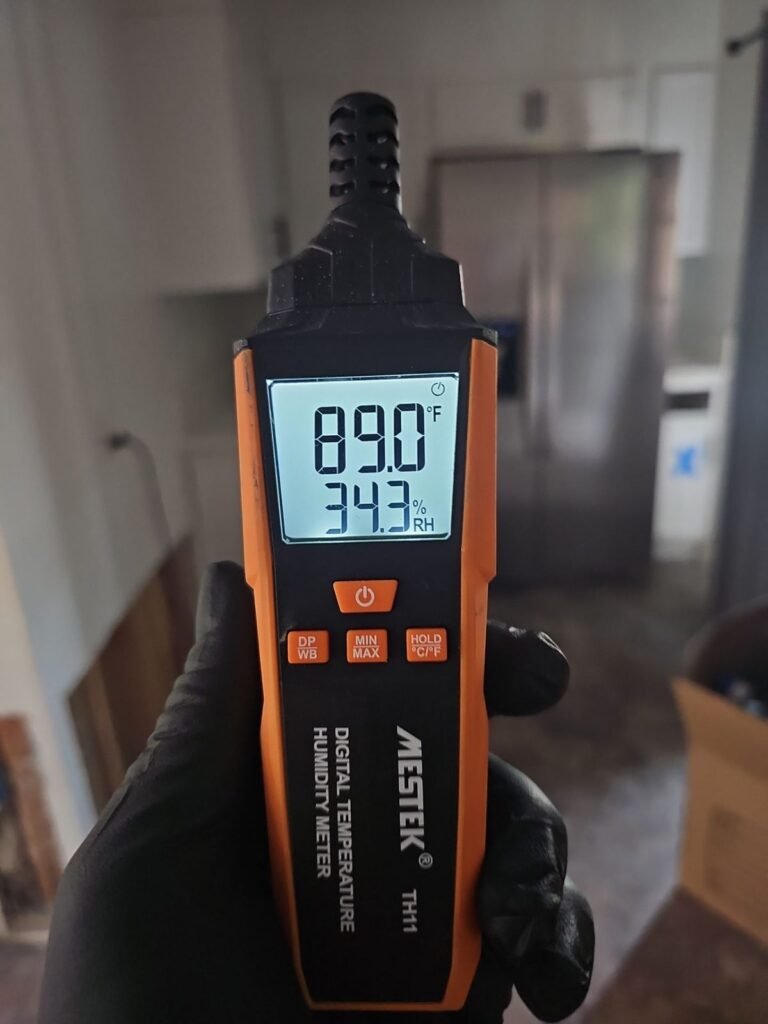
The technician on site walks the rooms with a moisture meter. Walls, subfloor and whatever the water climbed into behind the baseboard all get read. Then you hear what is wet and what only looks wet.
There is no charge for that visit and nothing to sign at the end of it. The readings are yours to take to whoever you want.
Two things are worth knowing before anybody signs. First, wet material runs on a clock. The EPA gives it 24 to 48 hours before mold starts. Let a call sit over a long weekend and the job grows before anyone opens the wall.
Second, what gets written down during that first walk becomes the case folder. That folder is the readings, the photographs and the itemized list your carrier settles the money from.
We measure, photograph and itemize. That is the paperwork half of a claim, and it carries more weight later than anybody expects.
What does this end up costing me?
The emergency half is hourly and the rebuild is one closed figure, by law rather than preference.
Drying and cleanup are billed by the hour. For water damage, the rate starts at $61 an hour. For emergency call-outs, fire, smoke and mold, the rate starts at $90 an hour. Equipment and materials go on top of the labor.
Where it lands depends on how many rooms the water reached and how long the equipment stays. It also depends on whether anything has to come out of the wall. The full rate sheet lives here.
The rebuild works the other way. A home improvement contract in California has to carry the total price in dollars and cents. That price is agreed and signed before the first tool is unloaded. So nobody can honestly meter a reconstruction by the hour.
Be careful with the numbers you find online. One company ranking here publishes the identical mold average for a beach city and for an inland one. That inland city sits twenty miles up the freeway, and the company blames coastal humidity in both.
Of a dozen restoration pages competing here, two publish prices at all. Neither of them publishes a license number.
We are not in a flood zone. So how did water get into the house?
Because the high-risk line on the federal map is not a line between wet and dry.
Of the 1,331 flood claims ever paid in this county, 535 were on property rated outside that zone. That is two in every five. The national share the government quotes is about one in five, so Ventura County runs at double it.
Inside the Ventura ZIP codes the split is starker still. There, 250 of 419 paid claims came from outside the high-risk area. In Oxnard it was 65 of 98.
The maps are not even the same age. Santa Paula, Fillmore, Camarillo and the unincorporated county run on maps redrawn in 2024. Oxnard, Ventura, Ojai and Port Hueneme are on maps from 2021.
Moorpark and Simi Valley still work from 2010, sixteen years of building ago. Two more facts people learn too late.
Flood is never part of a standard homeowners policy. A fresh flood policy usually needs 30 days before it switches on. And flood coverage pays for mud that traveled, not for a slope that simply let go.
The hillside behind us burned. What changes when it rains?
The soil stops drinking, and it stays that way for years rather than for a season.
After a fire the ground turns water repellent. Rain that used to soak in runs off instead, and it brings the hill with it.
The USGS ran the numbers basin by basin on the Mountain Fire scar. There, 0.42 inches of rain inside fifteen minutes puts the odds of a debris flow at fifty percent.
The Sandy Fire burned beside Simi Valley in 2026, and its scar faces its first wet season now. There the trigger is lower, about a third of an inch in the same quarter hour.
None of that is unusual ground here. Federal geologists have run eight post-fire emergency assessments for fires touching this county over the past decade. The Springs Fire burned above Camarillo Springs in 2013.
The mud arrived nineteen months later, filling ten houses to the roofline. Six weeks before that, moderate showers alone put mud waist deep on one street there. More recently a debris flow crossed every lane of the 101 near La Conchita.
Federal guidance puts the higher risk at up to five years, until the brush grows back. If it reaches your rooms, that becomes storm and mud work. What it leaves behind in the framing usually becomes a mold job a month later.
Someone knocked on the door the morning after with a contract. What am I signing?
Read the cancellation notice before you read the price.
A home improvement contract normally gives you three business days to back out. It is five if the buyer is a senior citizen. Seven business days apply to repairs on a home damaged by a sudden event that triggered a declared emergency.
That seven-day notice has rules of its own. It sits in bold type of at least 12 points, right beside the space where you sign. It comes with a detachable duplicate cancellation form.
And it is written in the language the sales pitch was given in. The statute names Spanish specifically.
Three more filters that cost nothing to apply. The contract must be written and signed before work begins. It must state the whole cost, profit and labor and materials together.
A deposit cannot run past ten percent of the contract, and the ceiling is often lower than that. And when a contractor breaks those rules inside an area under a proclaimed disaster, the court cannot go easy. The maximum fine is mandatory.
Storm chasers know all of this. They are counting on you not knowing it.
How long does the city take before the wall can close again?
Between two and nine weeks, and four of the ten cities publish no number at all.
Plan review is the desk your drawings sit on while somebody decides whether a permit issues. Almost nobody mentions it until you are waiting. Moorpark posts ten working days for a first plan review and five for the resubmittal.
Simi Valley posts twenty to twenty-five working days. Ventura posts twenty-one working days for electronic review. Oxnard reports ninety-five percent of first reviews finished inside nine weeks, with an express track of two to four weeks.
The unincorporated county says roughly four weeks. Camarillo, Thousand Oaks, Fillmore and Ojai publish no timeline whatsoever, and we are not going to invent one for them.
Local rules bite harder than the calendar does. In Ojai, the line is ten percent of a roof in one year. Repair more than that and the entire roof comes up to a Class A assembly. An eleven percent repair becomes a whole roof.
Fillmore stands alone among the ten. Its code demands a damage inspection after a fire touched structure, plumbing, electrical or mechanical systems. Port Hueneme inspects before it will issue the permit rather than after.
Camarillo stopped taking paper plans; everything moves through its portal. For homes lost in the Mountain Fire, the county deleted the zoning clearance step. It waived rebuild permit fees for owners who held the property the day it burned, through the end of 2026.
How do I check you out before a crew walks into my house?
Ask for the numbers, then go look them up yourself.
Ours are CSLB #1131134 on the construction side and IICRC #70194273 on the mitigation side. State law has required the license number in every form of advertising since 1973.
The regulation spells out what advertising means. It covers contracts, bids, signs, lettering on vehicles, and any electronic transmission. That includes the website you are reading.
So the absence of a number tells you something. Eight of the twelve restoration pages ranking in this county show no license number anywhere on them.
Then ask the question nobody in this market answers: who closes the wall? Drying and rebuilding are two scopes, two contracts and sometimes two companies.
A homeowner who assumes otherwise finds out in week three. Get both in writing. Both halves are ours, and you can still ask us to price them separately.
And what is not ours to decide?
Three things, and it is better to hear them now than in an argument later.
The claim belongs to the insurance company; their adjuster approves or denies it. Our job is to hand over readings, photographs and a scope of work. That is the line-by-line list of everything the loss requires, written so it is hard to wave off.
Past repair in kind, the structure belongs to an engineer. When framing has to change, an engineer stamps the drawing and we build to that stamp. And the results belong to the lab. People with a microscope read the sample.
No honest company certifies air it never sampled. In a house old enough to still have its first insulation, that reading also sets the order of the work. There, a sample goes to the lab before anybody opens a wall.
Work the loss did not cause is a separate contract, priced on its own. Anything outside those lines, ask on the phone or send it through the contact page.
You will get a straight yes or no about whether the work is ours or somebody else’s.
Rather not talk? Write it and we call.
The phone number carries the whole message. What you add only tells us which truck to load and how far it drives.
The water call that ends well usually starts with somebody describing a room out loud.