What a Rebuild Costs in Ventura County and Why You Won't Find a Price Here
SOS Restoration of Ventura County dries the house and then rebuilds it, from Oxnard to Ojai. The drying half runs on a clock. The rebuild half reaches you as one closed figure, because California does not let it reach you any other way.
This page explains what moves that figure. Call (805) 427-9039.
Because the number belongs on a contract with your name on it, not on a website.
California is unusually specific about this. The state Business and Professions Code, at 7159, tells a home improvement agreement exactly what to say. First the heading Contract Price, then the amount in dollars and cents.
Its companion, 7159.5, tightens the screw. That figure has to cover the entire cost of the job, profit and labor and materials together. Any finance charge has to be broken out separately.
A rebuild sold by the hour is not a pricing style somebody chose. It is a document that does not comply.
So what goes on a page is not a rate. It is the list of things that decide where your own total lands. Most of this market says nothing about money. A couple post an average, and that is where it gets funny.
The same figure turns up on a foggy coastal page and a dry inland one. Each carries its own climate explanation. A number that survives a change of city was never about your city.
Then what is the hourly rate for?
Mitigation, and only mitigation.
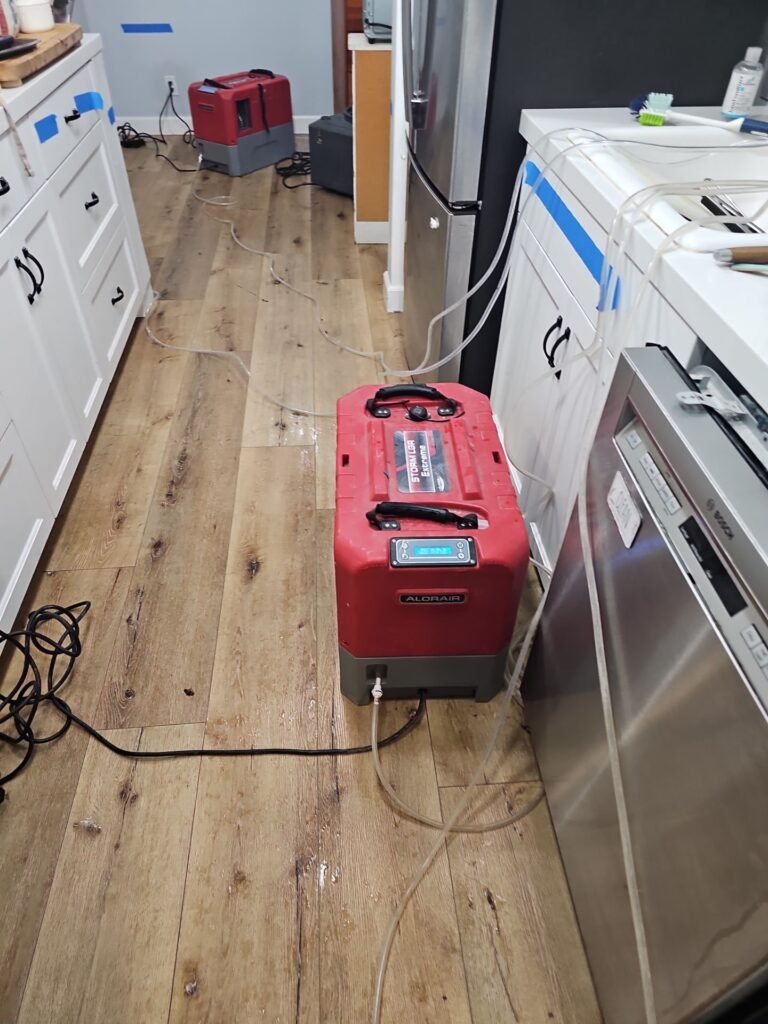
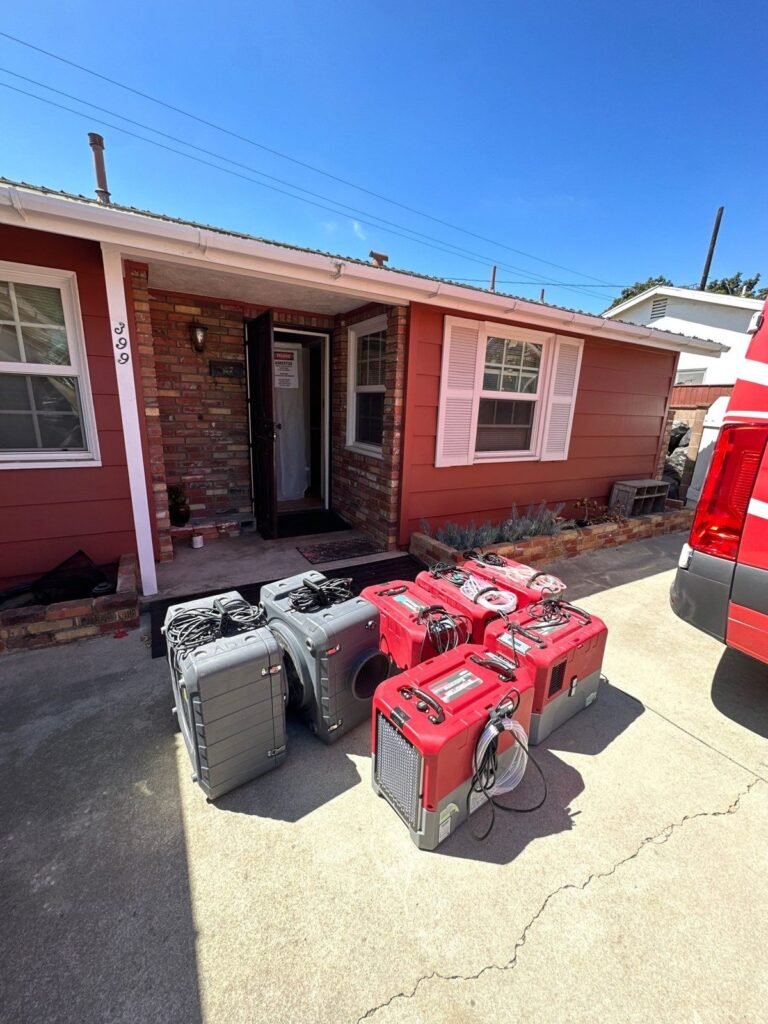
Extraction, air movers, dehumidifiers, containment, antimicrobial, and pulling out material that is not coming back. Nobody knows on the first morning how many hours a structure needs. So that half is metered: hours depend on moisture readings and end when the meter stops dropping.
Rounded off, our labor lands at $61, $69, $79 and $90 an hour by category of work. You will find which line applies to what on the drying cost page. Mitigation crews carry IICRC #70194273.
The technician on site puts a meter on the plaster and reads you the numbers off it. That way you learn which walls are genuinely still holding water. No charge for that visit, and nothing owed afterward.
What has to be true before anyone can hand you a total?
The work has to be countable, and while a wall is still wet it is not.
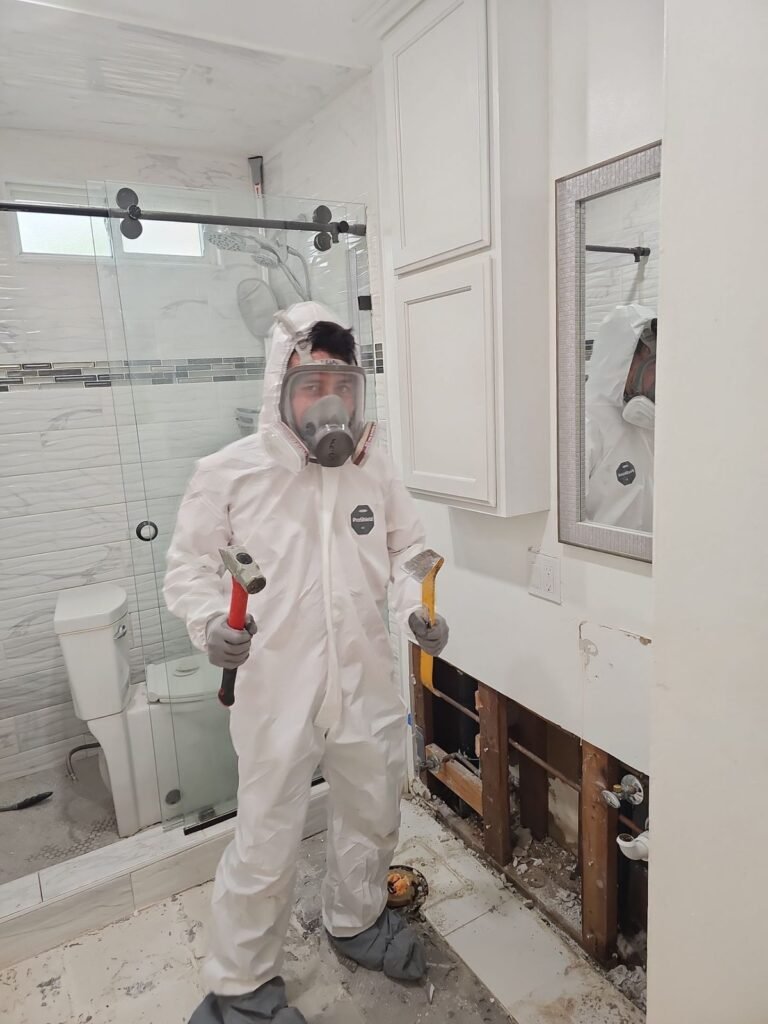
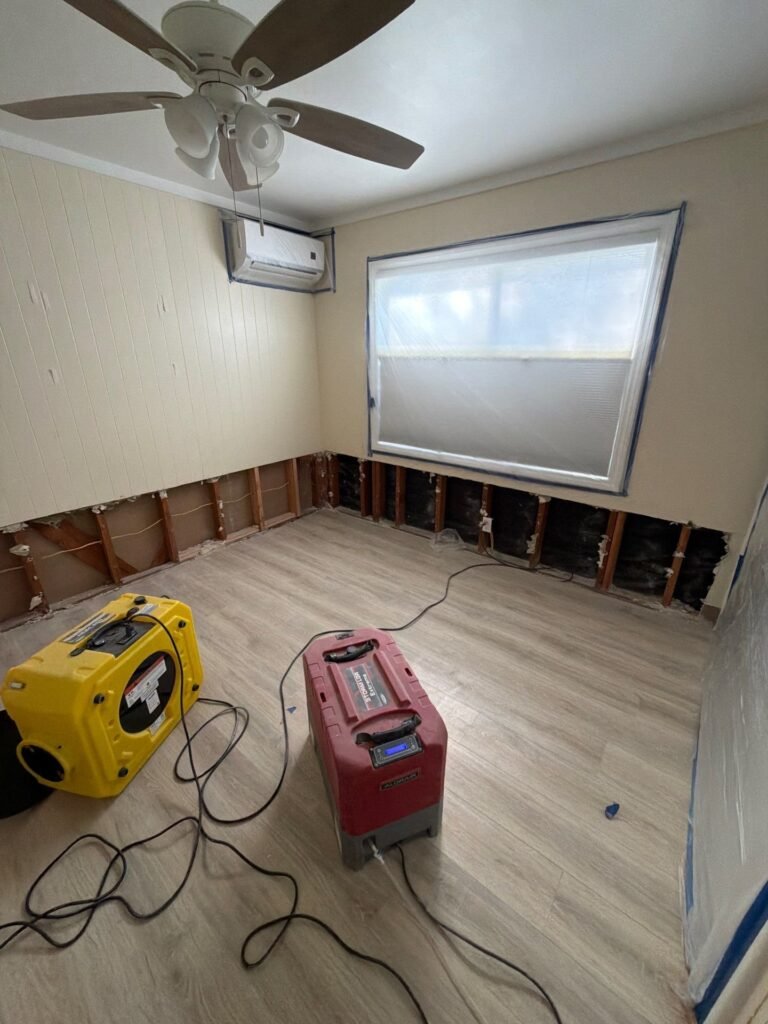
Nobody knows how much of that wall is leaving until it is open. After demolition it all turns into quantities. Baseboard by the foot, board by the sheet, floor by the square foot, doors, jambs, cabinet boxes.
That is when a fixed price becomes possible, and when to ask for one. The reconstruction side writes that list room by room, and the total is built up from the count.
What does the age of the house do to the number?
More than the size of the room does.
Ventura County holds 294,651 housing units, and 165,876 of them went up before 1980. That is 56.3 percent of the county, and it decides a lot of budgets.
Where you sit in the county changes the odds. Roughly three quarters of the homes in El Rio predate 1960. In Camarillo it is about one in twenty, in Thousand Oaks and Simi Valley a shade less. Same county, opposite paperwork.
What does the permit counter add that nobody warns you about?
Fees you can look up, and surcharges you cannot.
Camarillo stopped taking paper plans altogether. Everything moves through the portal now, and the review there is contracted out rather than run in house. On top of the published fees sit two percentages most owners meet for the first time on an invoice.
One is a general plan maintenance surcharge of 17.89 percent. The other is a technology surcharge of 11.34 percent. Neither is hidden. Neither is in the fee figure anybody quotes you.
Then there is the myth. Somewhere online lives a rule allowing ten square yards of drywall without a permit. No city here has it on the books, and neither does the county code.
Oxnard publishes fifty square feet for interior patching, and the City of Ventura publishes under one hundred. Both are counter guidance rather than ordinance, and either can change without an announcement. The county exemption list runs seventeen items; drywall is not one.
Three local rules move real money after a loss:
Ojai. Repair more than ten percent of a roof within a year and the whole roof has to come up to the highest fire rating the code recognizes, stripped to the deck. Eleven percent obliges a hundred.
Fillmore. A fire that damaged structure, plumbing, electrical or mechanical triggers a required damage inspection, written into the local code. The only one of the ten cities with that in writing.
Port Hueneme. Reroofing and exterior alterations need a compliance inspection before the permit issues, not after it.
The other schedule risk is plan check, the desk where drawings wait for approval before a permit issues. The unincorporated county publishes roughly four weeks for new projects and rechecks. Five of the ten cities publish a review time.
One publishes a figure buried in a document two decades old, and four publish nothing at all. Those four are listed here as not published, because a schedule nobody guarantees is worth what it cost to type.
Does a Mountain Fire rebuild work differently?
Yes, and two conditions on the county’s fee waiver get missed constantly.
If the loss traces back to that fire, this matters before you sign anything.
That fire started near Somis and ran through 19,904 acres. It destroyed 243 structures, 182 of them homes, most on unincorporated ground around Camarillo.
Zoning clearance was dropped for fire reconstruction, so an application skips the planning queue altogether. A small group of planners is assigned to nothing else.
The Board of Supervisors also waived a stack of building, sewage, grading, floodplain and administrative fees on those properties. Two conditions get missed.
The waiver runs until the end of 2026. It belongs to whoever owned the property the day the fire came through. It does not travel with the deed, so a lot bought afterward carries the fees again.
What is deliberately left outside the fixed price?
Six things, and each gets its price the moment it can be counted.
A closed number covers a defined list of work. Whatever cannot be defined yet gets priced when it can be. A bid that swallows it quietly is guessing with your money.
Abatement, meaning the licensed removal of asbestos or lead. Sample first, price after the laboratory answers. It is its own trade, on its own invoice.
Engineering. Questions about a header, a bearing wall or the slab go to an engineer. His name on the drawing, our hands on the carpentry, two invoices.
Whatever the plan reviewer demands. Review can order work that was perfectly legal the year the house was framed. Real money, nobody’s fault, unknowable until drawings go in.
Anything you choose to improve. A bigger shower, cabinets you like better, the floor you always wanted. It gets its own line item, kept plainly apart from restoration.
Belongings. Furniture, clothing, electronics, and the boxes in the garage.
What appears once the wall is open. Written up, priced, and signed by you before anybody continues.
How do you read a rebuild contract before signing it?
Five things, and not one of them needs any construction knowledge.
The heading Contract Price, with an amount in dollars and cents beneath it, and wording confirming that figure covers the whole job, profit and labor and materials, financing shown apart from it. Not a range. Not an estimate to be trued up later.
A deposit inside the legal cap. State law holds it to ten percent of the contract or a fixed statutory ceiling, whichever is smaller. On a rebuild of any size, the ceiling binds.
A payment schedule in dollars and cents tied to identified work. Nobody may request or accept a payment larger than the work already performed or the material already delivered.
What that license is allowed to cover. Ask it out loud, because a rebuild after a loss almost always needs at least two unrelated trades on one structure, and the narrower residential licenses cannot touch anything load-bearing.
The license number printed on the paper. Ours is CSLB #1131134.
What happens after you leave?
By the last day you are standing in rooms rather than framing.
Board, texture, paint, trim and doors, floor, and then the punch list. That is the short page of everything still not right, written by you. The outfit that metered your walls works it off.
Both halves, one company, billed two ways because the law bills them two ways.
The trouble is a question meant for somebody else, pointed at us. Two of those, weekly.
“Can you get this approved?” Wrong company. That one goes to your insurer. What we hand over is the case folder it decides from: measurements, dated photographs, an itemized count of what left the building. A yes from us would be a promise about somebody else’s decision.
“You’ll sign it off at the end, right?” Nobody signs their own work here. We apply, book the inspections, and build what the plan reviewer marked. The handwriting on that card is the city’s.
Equipment still running in the hallway, and no one has put a rebuild figure in front of you? Ask for one now, while every stud is still in plain sight.
Sewage backup cleanup in Ventura County: what leaves the house, how the wet line is measured, and who puts the room back. Call (805) 427-9039, day or night.
Two houses with identical damage can carry different rebuild numbers, because they sit in different cities. Each city has its own fee schedule and its own review queue.