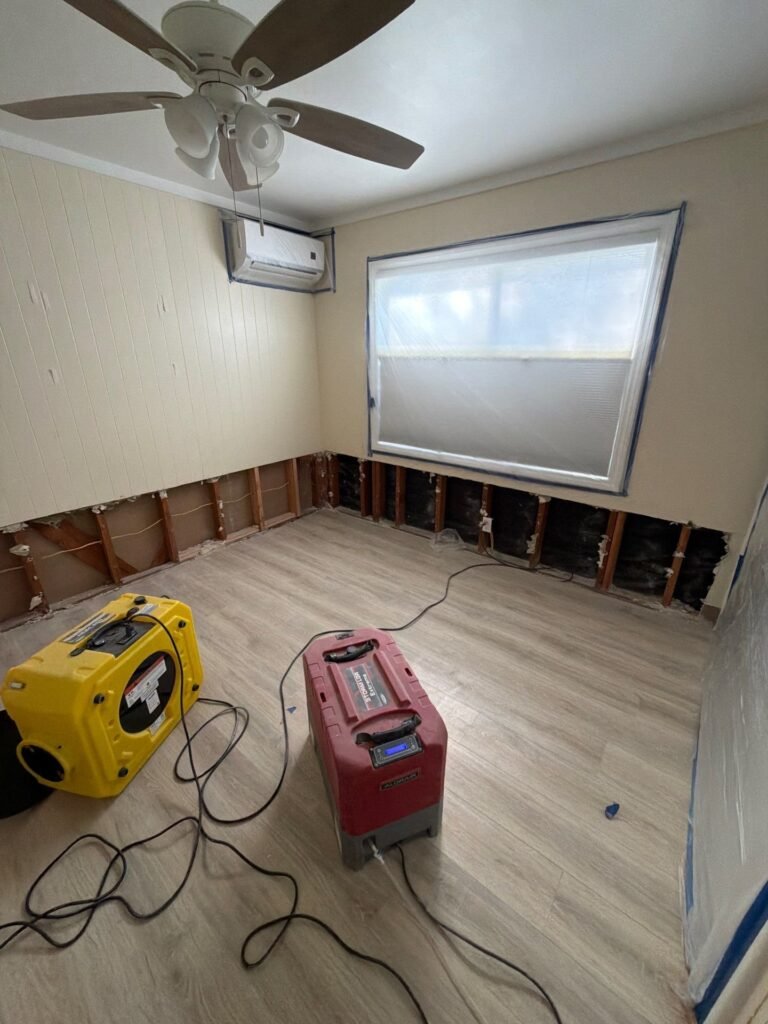
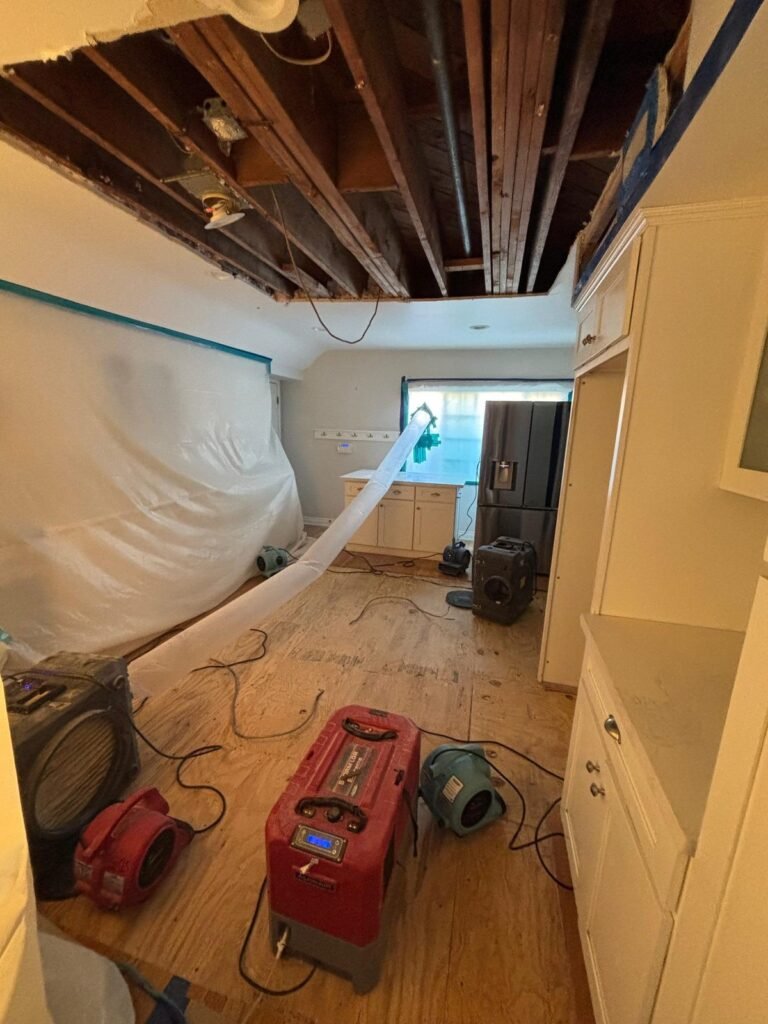
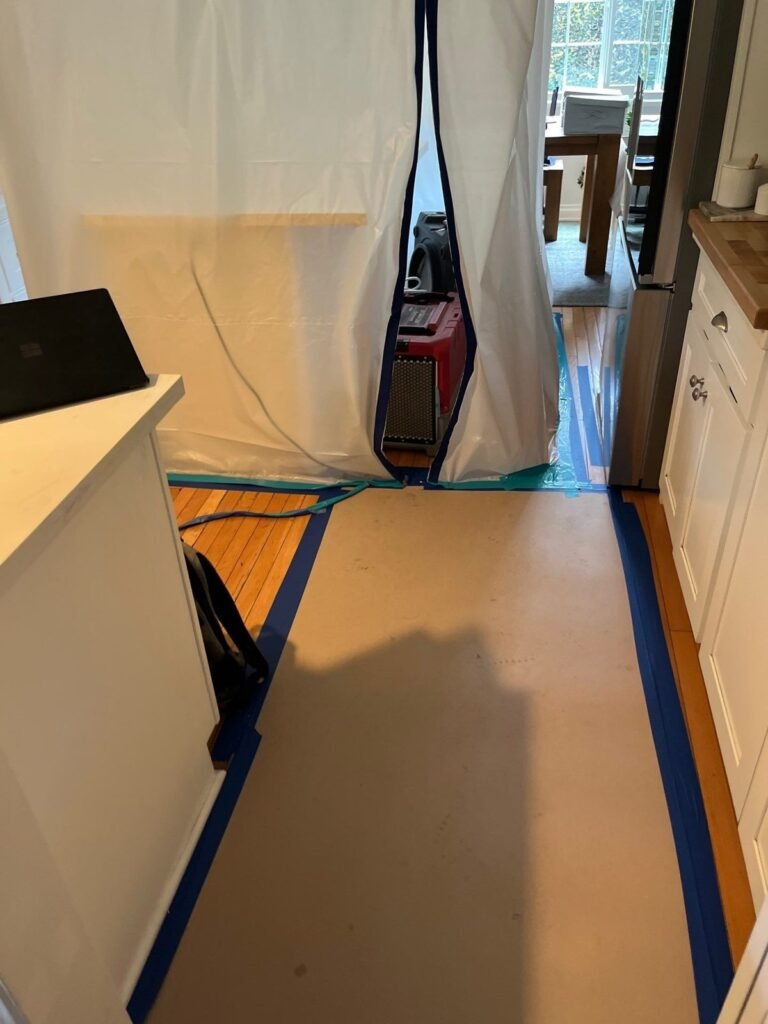
Santa Paula reaches SOS Restoration of Ventura County for the same six: water damage, mold, smoke, storm work, a sewage backup, and the reconstruction that finishes the job. Call (805) 427-9039 at any hour. Our dispatcher takes the street and the build year, and the first visit meters the walls before anybody prices anything. That visit costs nothing.
The Santa Clara River runs along the south edge of town, and the act of Congress behind the St. Francis Dam memorial names Santa Paula among the communities the flood of 1928 went through. Roughly 425 people died in it.
Nothing that size is coming back. What arrives instead is ordinary: a supply line behind a 1961 bathroom wall, a heater tank splitting open in the garage, a canyon creek rising faster than forecast.
Us, on (805) 427-9039. Spanish or English, whichever the house speaks.
Santa Paula drinks entirely from underneath itself. Five city wells draw on the Santa Paula Basin, and three of the five treatment points are arsenic filters while the others knock down iron and manganese. Those metals stain what they wet. So a garage water heater splitting open does not put a clean spill across the slab; it prints on carpet pad and wall board, and the print outlasts the water.
Water is most of it here, and mold is the quiet version. Sewage, storm and fire work round out five of the six, and the sixth is the rebuild afterward, which this company does rather than hands off. The drying side runs under IICRC #70194273.
The closest crew to you drives out, reads the meters and says which materials are wet, and that visit costs nothing either way. After that, water damage restoration starts at $61 an hour and moves with what the walls were hiding. Full rate card on the cost page.
Nobody answers that from the curb, and here the odds are worse than countywide.
Seven and a half of every ten Santa Paula homes predate 1980: 73.9 percent against 56.3 percent. The median build year in the city is 1970; for the county, 1977. So the ceiling gets a sample pulled before anyone puts a scraper to it, and what gets tested before a wall opens lays out the order.
Under that sits an older layer. 1,021 homes, 10.3 percent of the stock, date to 1939 or earlier, against 3.7 percent countywide, which is 2.8 times the share. They come apart differently: knob-and-tube wiring, plaster over wood lath, a raised floor over a crawlspace, and balloon framing whose stud cavity runs sill to attic, so water and smoke travel between floors.
Maybe not, and maybe for the first time.
The answer moved for part of this city in 2025, when FEMA’s Letter of Map Revision 23-09-1150P redrew flood map panels 0777F, 0779F and 0781F along Santa Paula Creek, following the Santa Clara River revision that took effect in 2024.
For roughly two decades the creek corridor carried Zone A99: high risk, but credited to a federal flood control project under construction and never finished. Santa Paula has 796 acres of it, more than any other city in the county, and the revision moves properties out into Zone AE or Zone X. Out of it, a mandatory purchase requirement may have quietly ended; into it, one may have quietly begun.
Scale is what outsiders miss: 40.2 percent of this city’s land, 1,422 acres, sits in FEMA’s high-risk area. The creek behind that number drains only 38.4 square miles and still ran 27,500 cubic feet per second in 2005.
A standard homeowners policy does not cover flood, which is the sentence that costs people most here. The city’s fact sheet never says how many parcels moved either direction, so an address gets checked one at a time with Engineering Services. What we contribute is documentation of where the water came from, because a claim turns on pipe or ground.
Cosmetic repairs, and drywall sits right on the edge of that line.
Santa Paula publishes no square-footage threshold for wall board, so it depends on what else got opened. And the ten square yards figure that circulates on contractor forums appears nowhere in the Santa Paula code, in the other nine cities of this county, or in the county’s. Somebody invented it and it spread. The city’s own exemption list stops at finish work: paint, tile, carpet, cabinets, counter tops, and window glass reset in an existing frame.
The rule that decides most restoration jobs is the plumbing one, stated cleanly. Clearing a stoppage or repairing a leak in a pipe, valve or fixture takes no permit. But a defective concealed trap, drain, waste or vent line that has to come out and be replaced with new material counts as new work, and new work takes a permit and an inspection.
Most of a real restoration job lands on the permit side anyway: structural repair, roof covering, stucco, water heaters, furnaces, and taking out a wall. The counter is Building and Safety inside the City of Santa Paula’s Community and Economic Development Department, on (805) 933-4218, with an inspection line around the clock on (805) 933-4210.
The city does not publish a plan check turnaround at all.
Its current building and safety pages carry no review time, and the only number Santa Paula ever printed sits in a manual dated 2006: three to four weeks for a first response, roughly three more after a recheck. That manual still points at a web address which stopped resolving long ago.
The route is easier to plan around than a date. Four sets of plans go in with a deposit figured on the value of the construction, and they travel to Planning, Building and Safety, Fire, and Public Works. All four approve before anything issues, and Fire here is Santa Paula’s own fire department rather than the county’s. Re-roofs, water heater replacements and panel upgrades come over the counter instead, though re-roofing does need a permit here.
Then come the clocks, which bite during a slow insurance conversation. Plan check expires 180 days after submittal, construction has to start within a year of issuance, and everything has to be finished inside three years. Those dates come from that same 2006 manual, so we confirm them at the counter. We pull the permit under CSLB #1131134 and stand for the inspections.
Ask before anyone cuts, because inside a mobile home park the permit may not be the city’s to issue.
California Health and Safety Code section 18300 puts mobilehome parks under state jurisdiction and overrides local ordinance. A city picks up enforcement only after thirty days’ written notice to the state department and its approval. Whether Santa Paula ever did is not something the state’s site would confirm, so the first call is the counter, and the answer decides who signs.
This is no footnote here. 1,034 homes in Santa Paula are manufactured or mobile, 10.4 percent of everything, against 4.0 percent across the county. One door in ten.
The building matters as much as the paperwork, because there is no slab. The floor is a deck over a cavity, the insulation hangs in a belly wrap beneath it, and the ducts run through that cavity. Water in the belly does not read on a meter from above, and the wrap holds it against the underside of the deck like a bag. So the belly gets opened and drained, which is how a manufactured home needs mold work months after a small leak.
Emergency work is yours to start; opening walls is the owner’s to authorize.
That call comes in from Santa Paula more than from most of this county, because 46.3 percent of occupied homes here are rented, against 35.8 percent countywide. A lot of doors here have an absent owner.
The split is cleaner than people fear. A tenant finds it and can get emergency work started, since stopping the spread is nobody’s argument. Opening walls and rebuilding needs the owner’s authorization, because it is the owner’s building. And there are usually two policies in the room: the structure is the owner’s to insure, the contents belong to whoever owns them. Sewage is the loss where waiting to settle that gets expensive.
The city’s own housing element, adopted in 2023 and signed off by the state’s housing department the following year, estimates that around 40 percent of the stock, roughly 3,600 units, needs repair for deficiencies or outright replacement, and it points at the denser older neighborhoods south and east of downtown. The document is straight that this is a staff estimate from observation.
Not an ozone machine and an afternoon.
Smoke odor lives inside materials, and it leaves when those materials leave or get sealed in.
This town has history with it. CAL FIRE puts the Thomas Fire’s ignition at Highway 150 and Highway 126, north of Santa Paula, in 2017, cause listed as power lines. It ran to 281,893 acres, destroyed 1,063 structures across two counties, and burned thirty-nine days before containment.
Thirty-nine days of smoke upwind is a different exposure than one house burning down the block, and it does not end with the fire. Weeks after the last flame, the National Weather Service logged mud and debris crossing Highway 150 near Steckel Park, up the canyon from here, after rain that exceeded the Geological Survey’s thresholds for that burn scar.
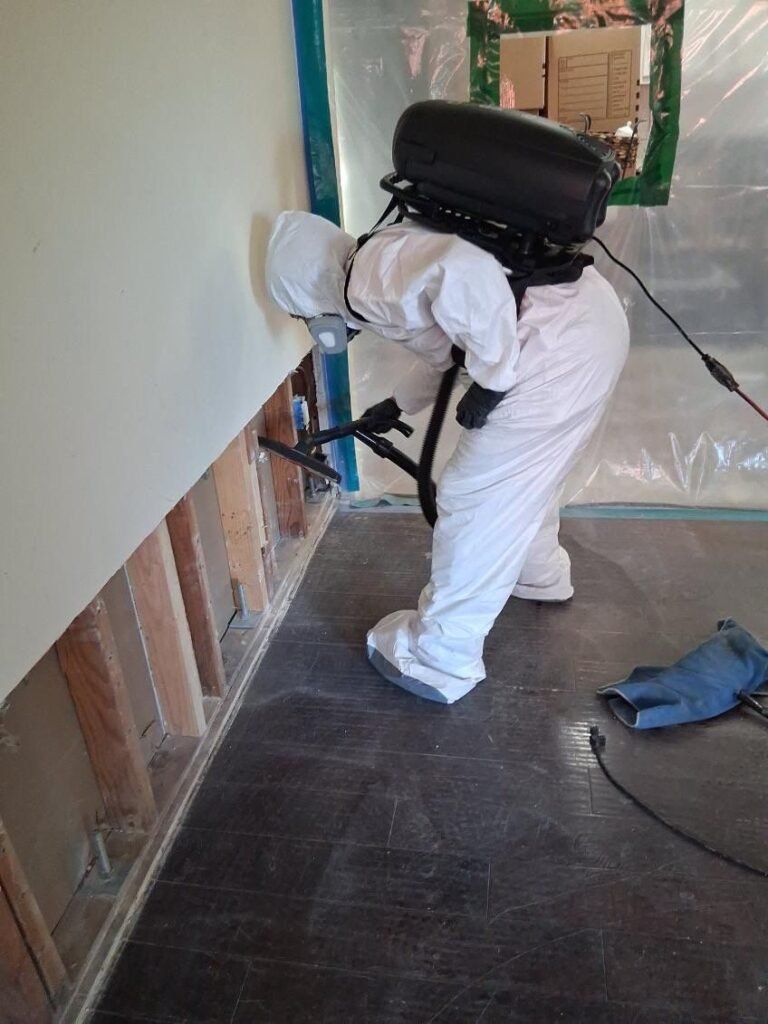
The work runs in an order. Dry before wet, because soot is acidic and a wet sponge etches it in. HEPA vacuum, dry sponge, chemical cleaning, then seal what stays and replace what will not release. Ducts get cleaned or replaced, or the furnace hands the smell back every winter. That is fire and smoke work.
Nobody hands you a gutted house and drives off.
The crew that cut out the wet framing puts framing back, then insulation, wall board, texture, paint, casing, doors, cabinets, counter and floor. That is the rebuild, sold as one written total settled before demolition starts, because California makes a home improvement contract carry its full dollar figure.
One Santa Paula rule is worth knowing before a plan gets drawn. The city’s manual calls for sprinklers in a new residence, and here is the part that surprises people: adding 1,000 square feet or more to a house that has none means sprinklers in the addition and in the original house too. We confirm that at the counter first.
Where we stop is worth saying plainly. The claim is not ours to decide; your insurance company does that. What we control is the folder: the measurements, the photographs and the itemized scope, which is the record your insurer works from when it settles what it owes. Past repair in kind, the detail needs an engineer’s stamp, and we build to it. The inspector signs the card, not us. Call (805) 427-9039 or use the contact page. How the rest of the county gets covered starts on the home page.
A river town in the citrus belt, with the Santa Clara on one side and the hills on the other. The water history here is older than most of the county.

Your phone number is the only thing we really need. Everything else just helps us send the right crew with the right equipment.
If a Santa Paula floor is wet, call (805) 427-9039 and say which street you are on. What you should be left with is a stain that is gone rather than painted over, the iron-and-manganese print lifted off the carpet pad, and a house that reads dry on a meter you watched somebody use.