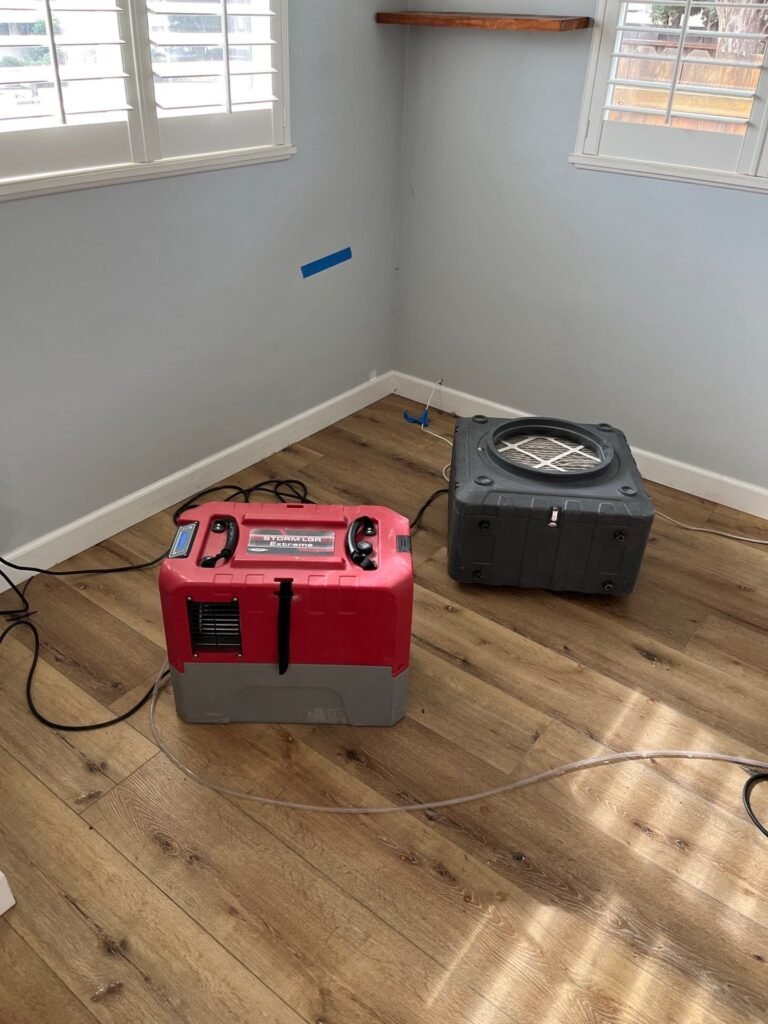
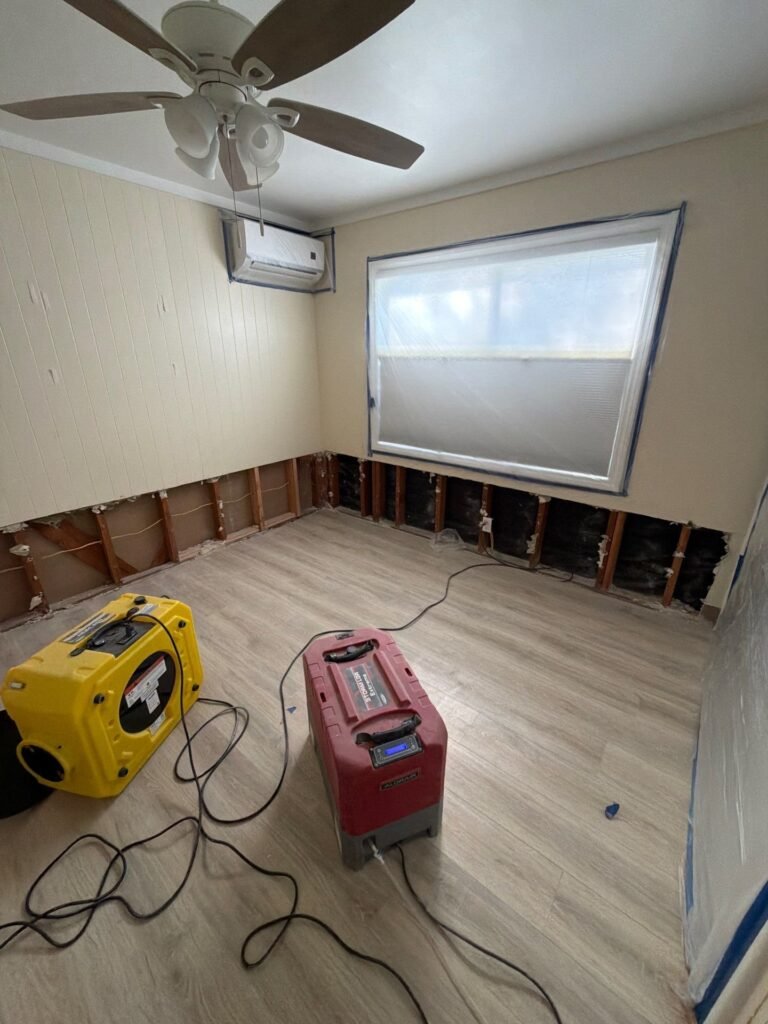
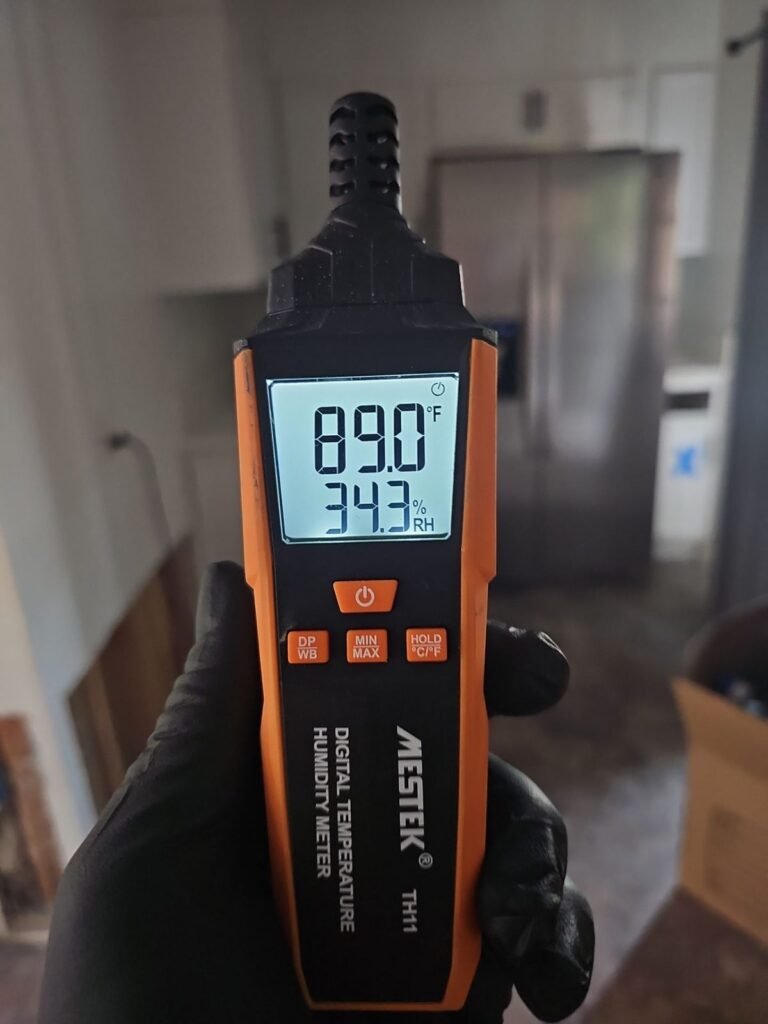
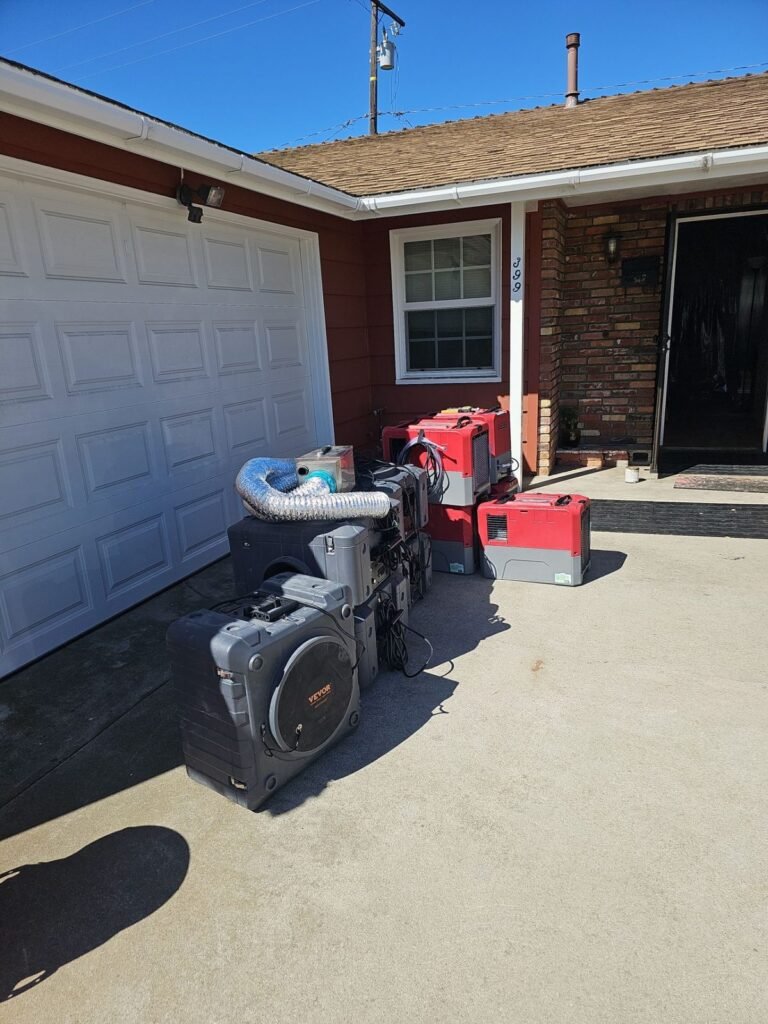
SOS Restoration of Ventura County works both halves of a loss in Ventura: a wet floor, mold behind tile, a sewage backup, smoke after a fire, storm damage, and the reconstruction that puts the room back. Two houses in three here went up before 1980, so the first visit reads the walls with a meter before anybody prices a thing, and it costs nothing. (805) 427-9039.
There is: 100 square feet of interior plaster or drywall repair, and no more.
Ventura’s Building and Safety Division sets that line, and crossing it puts you in permit territory. That figure is counter guidance and a local amendment to Section 105.2, not a right you can wave at an inspector. The ten square yards that circulates online belongs to no city in this county, Ventura included.
What Ventura does not publish is a plan check turnaround. Its own answer is that turnaround shifts with the stack of drawings in the office, and plans get read in the order they arrive. We are not going to improve on that with a guess. Three doors exist: instant residential permits through Symbium, counter permits needing no plan review, and plan-check permits for new construction, remodels and tenant improvements. A water heater swap needs a permit but no plan review. The Permit Center takes walk-ins four days a week and closes on the fifth; the line is 805-654-7869.
One more check: a 93001, 93003 or 93004 mailing address does not prove you are inside the city. Unincorporated Saticoy and the Ventura Avenue corridor answer to the Ventura County Resource Management Agency instead. Other office, other exempt list.
Forty square feet of waterproof covering, and no deeper. Reach the underlayment or the structure and it is a permit. Then Ventura’s own amendment bites: this city lifted the state floor from Class C to Class A on every parcel, so replacing more than half a roof in any twelve months drags the whole roof up to a Class A fire-retardant covering. Wood shakes and shingles are banned outright as a covering, treated or not.
Probably, and not the kind of flood zone people picture.
FEMA maps roughly 3,100 acres of Special Flood Hazard Area inside these city limits, and the biggest slice, 1,975 acres, is Zone VE: coastal ground where the hazard is wave velocity, not a river climbing its bank. Another 710 acres are AE and 348 floodway. The beach strip along Pierpont Lanes is in the one percent annual zone. So is the Ventura River west of the VR-1 levee, the Santa Clara River where it passes the Olivas Park and Buenaventura golf courses, Arundell Barranca below Main Street and Harmon Barranca below Telegraph Road.
A standard homeowners policy does not cover flood, which is why 419 paid federal flood claims across the 93001, 93003 and 93004 ZIP codes since 1978 ran through a separate program. The map is not a promise either: of the county’s 88 repeatedly flooded properties, 30 sit in 93001 alone and 24 are drawn in low-risk zones. Whether a repair trips the substantial damage rule is a question for the city’s Floodplain Management office at 805-654-7887, not for a contractor.
Inside the coastal zone, possibly, and the calendar is the part that hurts. Ventura has issued its own Coastal Development Permits since finishing its Local Coastal Program in 1984, and development there is written broadly enough to include demolition and reconstruction. Administrative coastal permits are heard twice a month. Then come up to ten calendar days of appeal to City Council and, inside the Appealable Development Area, ten more to the California Coastal Commission. The city says it flatly: no building permit issues during those appeal windows. Drying waits for none of it. The rebuild does, so drawings go in early.
Ventura runs its own collection system and carries an ordinance most of its neighbors do not.
Municipal Code Chapter 22.250, in force since 2014, wants a video inspection of the private lateral, meaning the buried pipe your deed makes yours rather than the city’s, before escrow closes on a residential sale, with the report filed at Building and Safety and the finding disclosed to the buyer. Apartments, condominiums and commercial buildings get their laterals looked at every ten years. If you bought here after 2014, that video exists. Now is a good time to find it.
Between 2007 and 2023 the city logged 103 sanitary sewer overflows, 57,107 gallons out and 17,250 reaching surface water, and the leading cause was not grease. Tree roots took 45 of the 103. A 2025 failure released 23,575 gallons on Carlyle Street after debris took out a pump station. The city’s wastewater desk answers at 805-677-4114. Our end does not shift with whose pipe it was. Water out of a sewer is category three, the dirtiest grade there is: everything porous it soaked leaves the building, and the framing gets cleaned, dried and written up before new board goes on.
Start with who owns the pipe, because in this city it is the city.
Ventura Water is a municipal department, not a private utility and not an outside district, and this is one of the larger Southern California cities running wholly on local supply: the Ventura River at Foster Park, Lake Casitas, three groundwater basins. Oxnard and Camarillo import. A broken main here is a City Hall conversation from the first hour.
The city has also written down which pipe is tired. Its capital plan for 2027 through 2031 lists as unfunded the asbestos-cement main laid in 1952 beneath Glen Ellen and Court Avenue, in 1955 in the Dunning neighborhood of Midtown, where iron clamps keep letting go in corrosive soil, and in 1963 in the Plumas neighborhood of Saticoy, with its running history of main breaks and valve failures. If that is your street, the origin of the water is half of what gets argued about later, so we time it, photograph it and itemize it on day one.
Nobody at the city publishes that figure, and the Thomas Fire rebuild is the honest measure.
That fire took 686 structures inside these city limits alone, burned 281,893 acres across two counties and destroyed 1,063 buildings across the winter of 2017 and 2018. By late 2025 the city counted 404 homes rebuilt and cleared for occupancy, 31 permits in active construction and 18 still in plan check. Eight years on, still counting.
The Thomas Fire Rebuild Overlay Zone ended with 2025. Its cheaper fees and loosened standards needed a permit issued before that date, so an empty lot in Ondulando or Clearpoint now walks in the ordinary door. Behind that door sits fire mapping that is the rule here, not a corner: 2,498 acres in the Very High severity zone against the northern foothills, and a Safety Element saying only the densest core of the city falls outside it. The map Council adopted in 2025 counts more than 4,600 acres High or Very High and does not reconcile with the older figures, so which governs your parcel is a counter question. Very High also pulls in Chapter 7A: ignition-resistant eaves, vents and siding.
Smoke keeps its own calendar. Odor returning on the first warm afternoon months later is usually still in attic insulation and ducts, and paint does not hold it down.
Either one can, and here it comes up constantly: this is not a town of owner-occupied houses.
Of 41,858 occupied units, 44.1 percent are rented. Detached single-family is 53.9 percent of the stock, 29.8 percent sits in buildings of two units or more, and 2,251 units are mobile or manufactured, which dry on their own plan. Call and we stop the damage growing at once; authorization to proceed belongs to whoever holds title, and chasing that signature is our errand.
That 29.8 percent hides a local trap. Ventura’s amendment R103.3(4) requires automatic sprinklers in an existing building when permitted renovation strips the ceiling or exposes roof or floor framing across more than 75 percent of total floor area. Single-family homes are excepted. Apartments and commercial are not. An enthusiastic tear-out in a fourplex can turn a drying job into a sprinkler project, which is why somebody measures exposed area while the saw is still moving.
Mitigation gets billed by the hour.
Water damage restoration opens at $61 an hour, water damage repair at $69, cleanup and flood work at $79, and an emergency call-out, fire and smoke, mold, structural drying and odor at $90. Those are opening figures and the job moves them. How an invoice reads line by line is set out under water damage restoration for the county.
The rebuild cannot be sold that way, and that is statute rather than preference. Business and Professions Code section 7159 makes a California home improvement agreement state its whole cost in dollars, so the reconstruction half arrives as one written figure settled before demolition starts. What pushes that figure here is specific: Chapter 7A materials, a Class A roof once you cross half the roof area, a coastal appeal window sitting in your calendar.
The first visit is free and nothing attaches to it. Our nearest crew walks the house, finds the edge of the water with a meter, names the walls that are soaked, and leaves either way.
Then the job is closed: dry readings that hold, ruined material gone and itemized, board and paint back up.
Three signatures still land, none of them ours.
One is the inspector’s, on the permit card. The permit comes out in our name, CSLB #1131134, and the work is built to code; the walkthrough is Building and Safety’s call.
One is the engineer’s on a drawing, or a laboratory’s on a result. Past repair in kind, a beam gets drawn and the framing follows it; in housing stock this old the sample comes back before the saw starts, and what has to be tested first covers which materials get read in a lab instead of by eye.
The last belongs to your insurance company, on the settlement. From us come dated moisture logs, photographs of each wet room before a fan ran, and a list of what got hauled out; you file it. If this is happening right now, call (805) 427-9039. Every other way to reach us lives on the contact page, and the home page lists each service and city we cover.
The county seat sits where the Santa Clara River meets the ocean, so it gets both kinds of water. Oxnard is ten minutes down the coast; Ojai is up the valley behind it.

Your phone number is the only thing we really need. Everything else just helps us send the right crew with the right equipment.
If something in your Ventura house is wet or burned, call (805) 427-9039 and our dispatcher will send the crew closest to you. What you want at the end is a lateral with a video behind it, a permit card somebody else signed, and a room that gives nothing away.