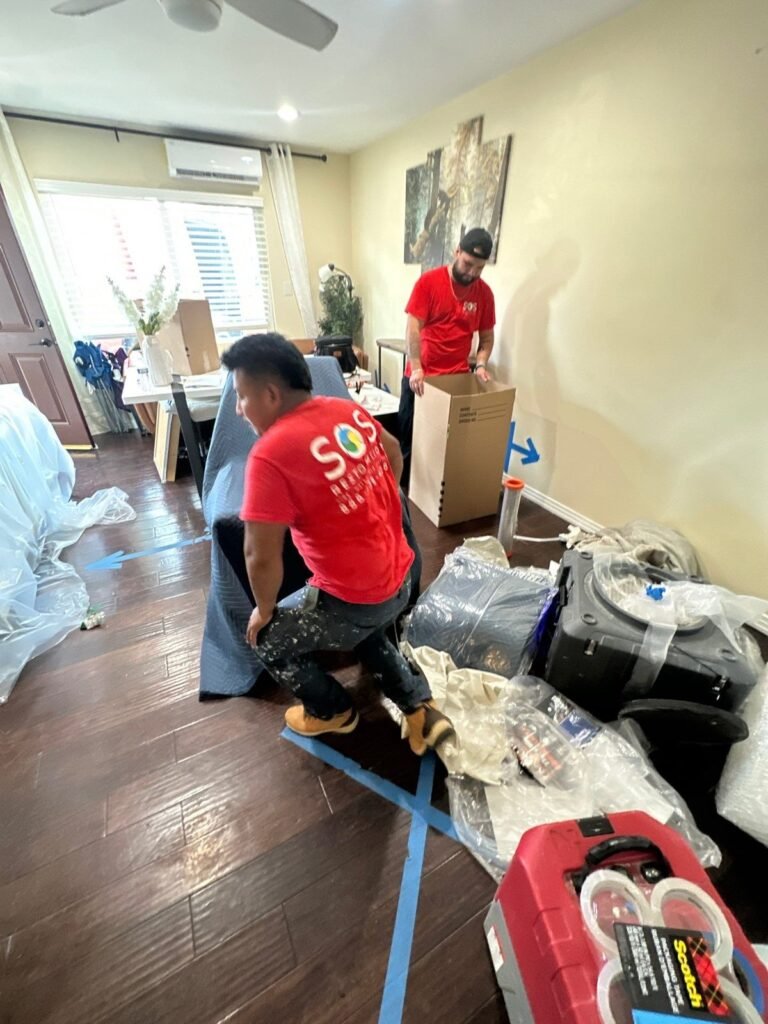
SOS Restoration of Ventura County covers six kinds of work in Thousand Oaks: water, sewage, fire and smoke, storm, mold, and the reconstruction that brings back framing, drywall, texture, paint, cabinets and floors. Houses and commercial buildings, Spanish or English, and no figure goes on paper until a technician has been through the rooms. (805) 427-9039, at any hour.
Shut the water off, cut the power or the gas feeding the heater, then call (805) 427-9039 and leave the rest where it is.
That first step is harder here than it sounds: four separate companies sell drinking water inside one set of city limits. The City of Thousand Oaks runs its own system, California American Water keeps an office in Newbury Park, California Water Service covers another slice of the Conejo Valley, and Camrosa Water District covers a third; all four buy wholesale from the Calleguas Municipal Water District. The municipal system moves up to fifteen million gallons a day to roughly 17,000 homes and businesses, in a city holding 48,084 housing units. Most addresses here are therefore not city water customers at all. Read the top of your bill before you go hunting for a shutoff; if the street valve will not turn, our crew carries the key. The City of Thousand Oaks takes utility calls at (805) 449-2201, and the extraction and drying starts the minute the supply stops.
Yes, and in Thousand Oaks that is the ordinary case rather than the unlucky one.
Of 48,084 housing units in the city, 27,167 went in before 1980, and 15,696 of those landed inside one stretch of ten years between 1970 and 1979; the median build year is 1978. Nothing comes out of a floor that old until a sample clears the lab, and what gets sampled before a wall opens walks through the order it happens in. Drive to Moorpark and the arithmetic inverts: barely one home in five there predates 1980, and its median is 1987.
Finish work goes back with no paper at all, and the city publishes neither a square footage for drywall nor a plan check timeline, which is more useful to know than any guess would be.
The exemption list lives in section 8-4.09(b) of the municipal code, running under the 2025 California Building Codes that Ordinance 1741-NS brought into force in 2026. That list names painting, wallpaper, tile, carpet, cabinets and countertops as finish work nobody has to pull anything for. Wall board is not on it. The one figure in there that matters after a storm is the roof: covering repair stays exempt up to 100 square feet within any twelve months, and only while it is not the entire portion of one roof type.
If somebody tells you the cutoff is ten square yards, they read that on the internet. The figure appears nowhere in the Thousand Oaks ordinance and nowhere in the county’s.
Emergencies get one narrow allowance. Section 8-4.09(b)(28) says that when equipment must be replaced right now and a permit is required anyway, the application goes to the Building Official on the next business day. An emergency moves the paperwork by a day; it does not delete it. Plumbing, mechanical and electrical permits go through a contractor holding a state license, ours is CSLB #1131134, unless you qualify as an owner builder in the home you occupy yourself. The Building Division at the Community Development Department will only say that it tries to process a permit as soon as it can during counter hours, so treat any promise of a specific week as somebody quoting another city. Their number is (805) 449-2320; ours sits on the contact page.
Check this before anybody applies for anything, because it decides which counter the permit comes from.
Casa Conejo, Ventu Park and Upper Ventu Park carry Thousand Oaks mail and Thousand Oaks neighbors, and not one of them sits inside the city. They fall under the county’s Thousand Oaks Area Plan, and their permits are issued by Building and Safety at the Ventura County Resource Management Agency. Part of the flood mapped ground along the South Branch Arroyo Conejo lands in Casa Conejo, so a single channel can put two neighbors in two different jurisdictions.
Fire authority splits the same way, and it surprises people: there is no city fire department here. Every parcel inside the limits is Local Responsibility Area, meaning the Ventura County Fire Protection District answers for it, while the unincorporated slopes wrapped around town are State Responsibility Area, which puts them on CAL FIRE. The State Fire Marshal redrew those local zones and the new maps took effect in 2025, which changes what a rebuild has to meet on the hill side of a street.
One channel is responsible for almost all of it: the South Branch Arroyo Conejo.
Roughly 300 properties backing onto that channel have been required to carry flood coverage since FEMA revised the national program’s maps in 2010. In 2020 the Army Corps of Engineers looked at it and concluded the water is coming from local drainage that cannot keep up, not from the channel itself. The city and the county water district signed a memorandum in 2023 to fund a hydrology study together, with a final draft expected early in 2027.
Citywide the exposure looks tiny, and the small number is exactly the trap. 411 buildings and 1,132 people, under one percent of Thousand Oaks, sit in the FEMA 100 year zone, while only 336 flood policies are in force against 46,546 occupied households. Five properties in town are flagged as repetitive loss. The city does not take part in the Community Rating System, so no municipal discount comes off anyone’s premium here. A homeowners policy does not cover rising water, in this city or any other, and most of the neighbors who flood find that out on the day it happens.
One local rule runs the other direction and is stricter than the federal floor: city ordinance 1995-20 requires every new building pad to be protected against a 100 year flood whether or not FEMA ever drew it on a map.
Smoke does not need flame to get into a house; it needs a gap, and every house has gaps.
Thousand Oaks carries more buildings inside the Very High fire hazard severity zone than any other incorporated city in Ventura County: 17,407 of them, 16,638 of those residential, with 58,118 residents living inside that zone, 45.8% of everybody in town, and close to 44% of the value of everything built here. Simi Valley holds 10,911 buildings in the same zone, Camarillo 1,241, and Oxnard and Port Hueneme none whatsoever.
The record is close to home. The Hill Fire started in 2018, in Hill Canyon a mile west of town, and took 4,531 acres. Twenty-one minutes later the Woolsey Fire started, ran to 96,949 acres and destroyed 1,643 structures. Neither one tops the city’s own ledger of damaging events; the Green Meadow Fire of 1993 still does.
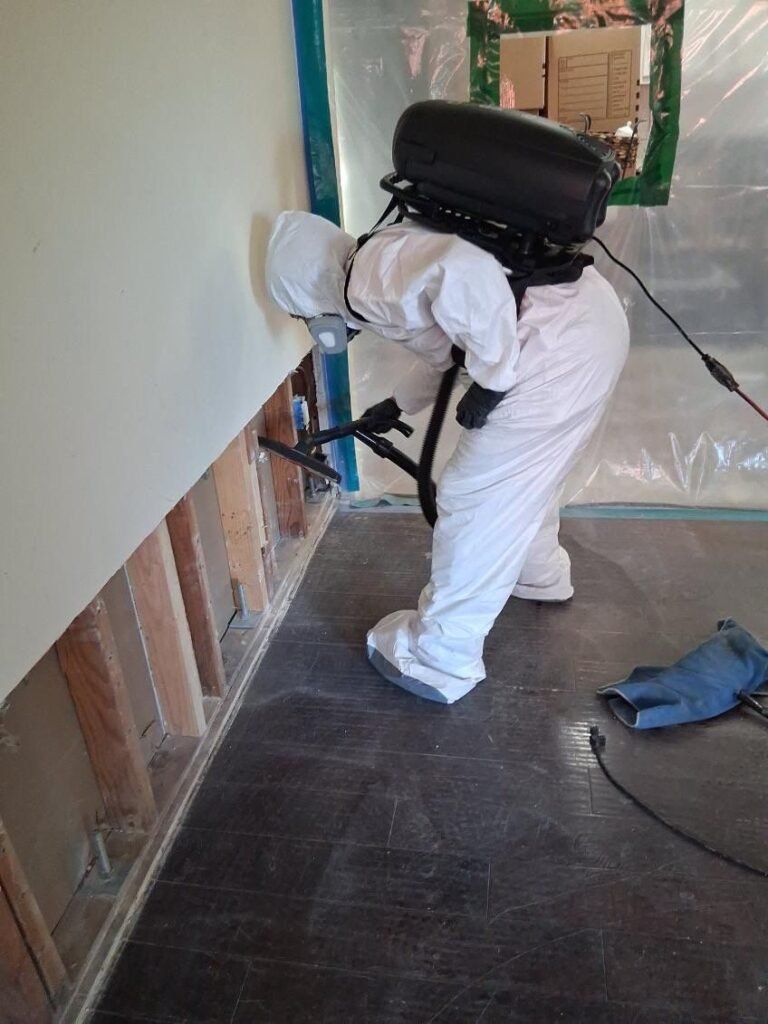
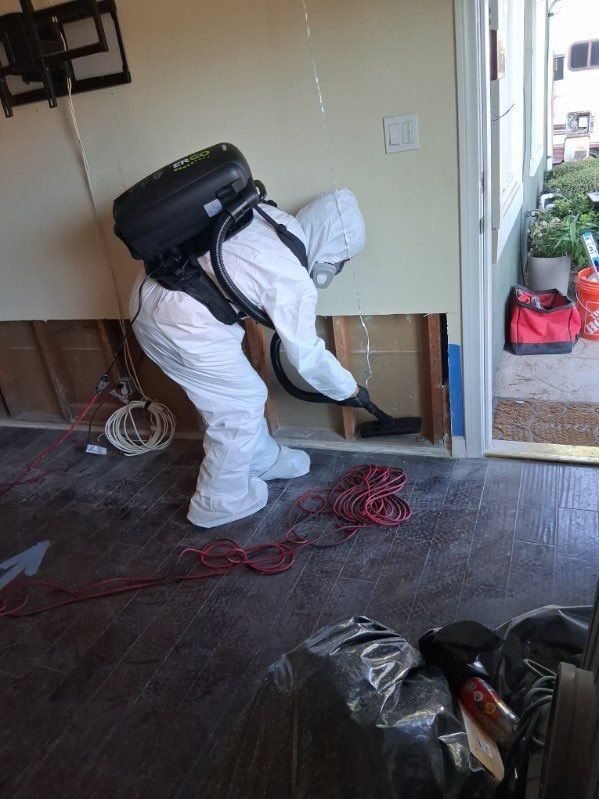
What a smoke job removes is odor held in porous material. Soft goods, insulation and anything charred leave the building. Framing and hard surfaces get cleaned and, where the smell has soaked into the substrate, sealed before paint. Air runs through filtration throughout, so the fine ash is not relocated to the next room. We do this across Ventura County, and here we do a lot of it.
It is worth fixing, and it is not the horror story the internet sells.
Public health guidance does not support singling out one species as uniquely poisonous. What matters is how long the material stayed wet and how far the water traveled unseen.
The ground under Thousand Oaks is part of why slab leaks turn up here. In the city’s own hazard ranking, landslide scores 51 and wildfire 36, so the top risk on that list is ground that moves, not hills that burn. Expansive clay sits across the whole city, shrinking through the dry months and swelling when it gets wet, and that cycle is hard on a slab and on the copper running inside it. Liquefaction zones follow Lang Creek from Oakbrook Regional Park across State Route 23 to its junction with the Arroyo Conejo, run beside the 101 heading into Newbury Park, and appear again on Hill Canyon Road where the North Fork Arroyo Conejo meets Conejo Creek.
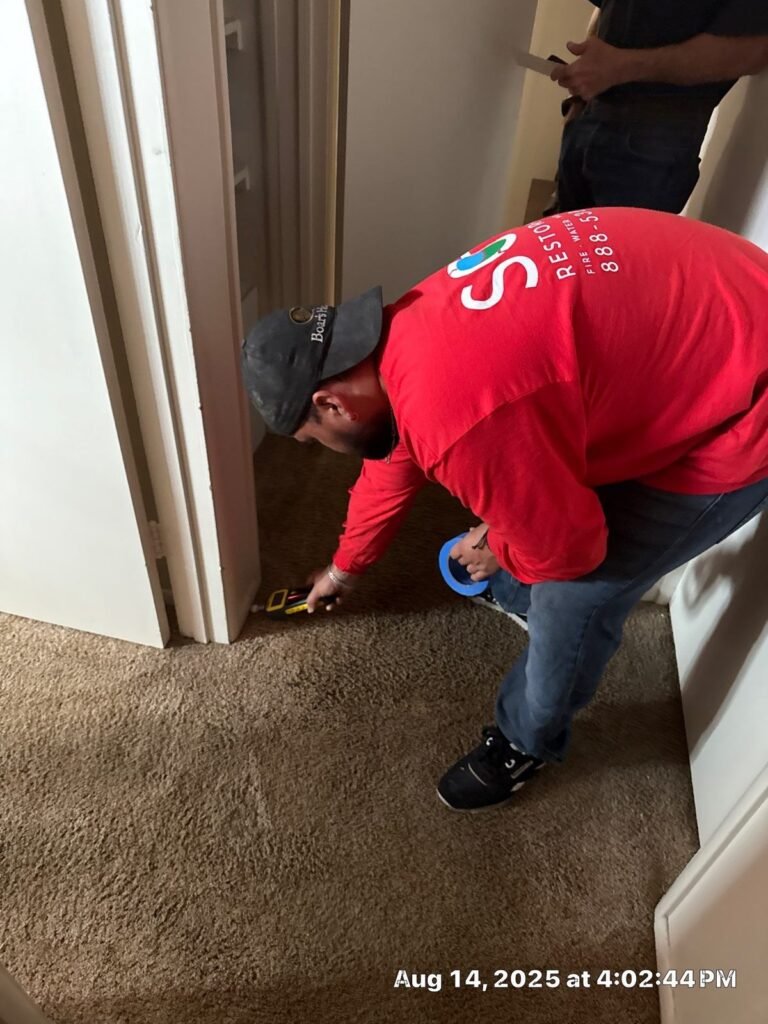
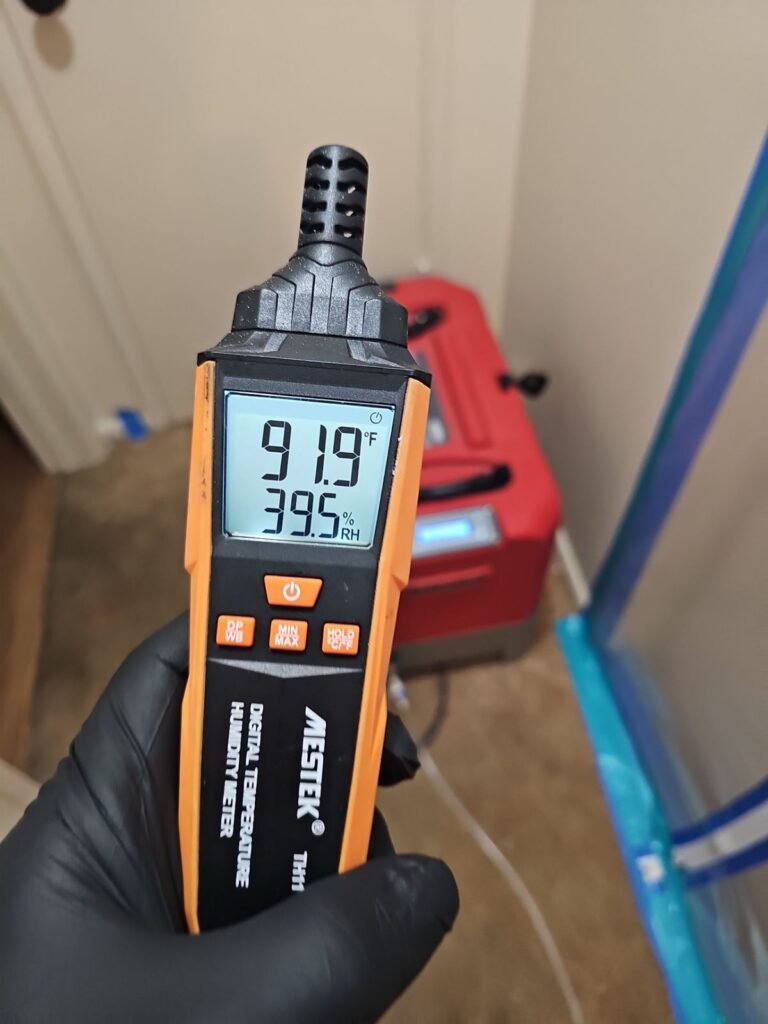
The census does not publish how many houses here sit on a slab and how many over a raised foundation, so nobody can tell you which you have from a desk. We find out with a meter and a camera on the first visit, and nobody is charged for that visit or asked to sign anything at the end of it.
Mitigation runs on an hourly rate, and these starting points hold in every city we cover.
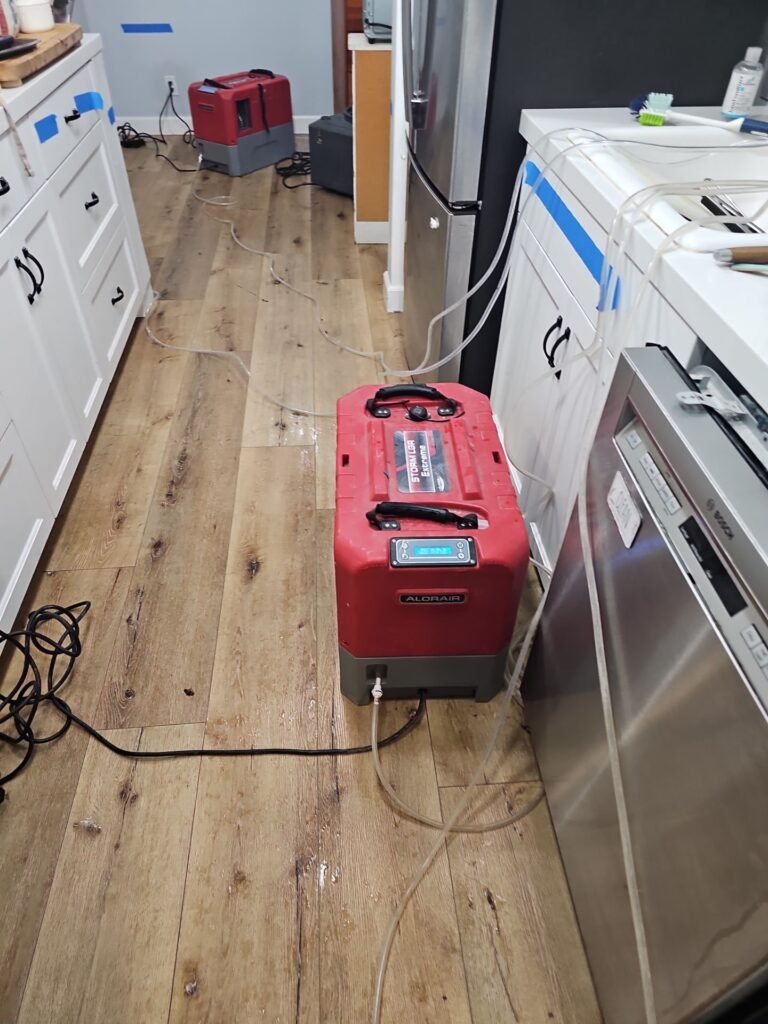
Water damage restoration and residential restoration start at $61 an hour; water damage repair and water restoration at $69; water damage cleanup and flood damage restoration at $79; and the emergency call out, fire and smoke, mold, storm work, structural drying, dehumidification and odor at $90. What moves a job up that scale is the hours the water sat before anybody found it, the volume of material leaving the house, and the count of machines it takes to dry the rest.
The rebuild cannot legally work that way. Under §7159 of the California Business and Professions Code, a home improvement agreement is invalid in this state unless it states the whole price in dollars on its face, so the reconstruction comes as a single number in writing, agreed before demolition starts.
A Thousand Oaks wrinkle decides who signs it. 5,471 homes in this city are attached, townhouse or condominium sharing a wall, and 13,593 of the 46,546 occupied households are rentals. Inside an attached unit the association may be the party that authorizes opening a common wall, and in a rental the owner signs, not the tenant. Settling that on the first visit keeps a one-day question from eating a week.
The room is finished before we go, and one folder leaves with you.
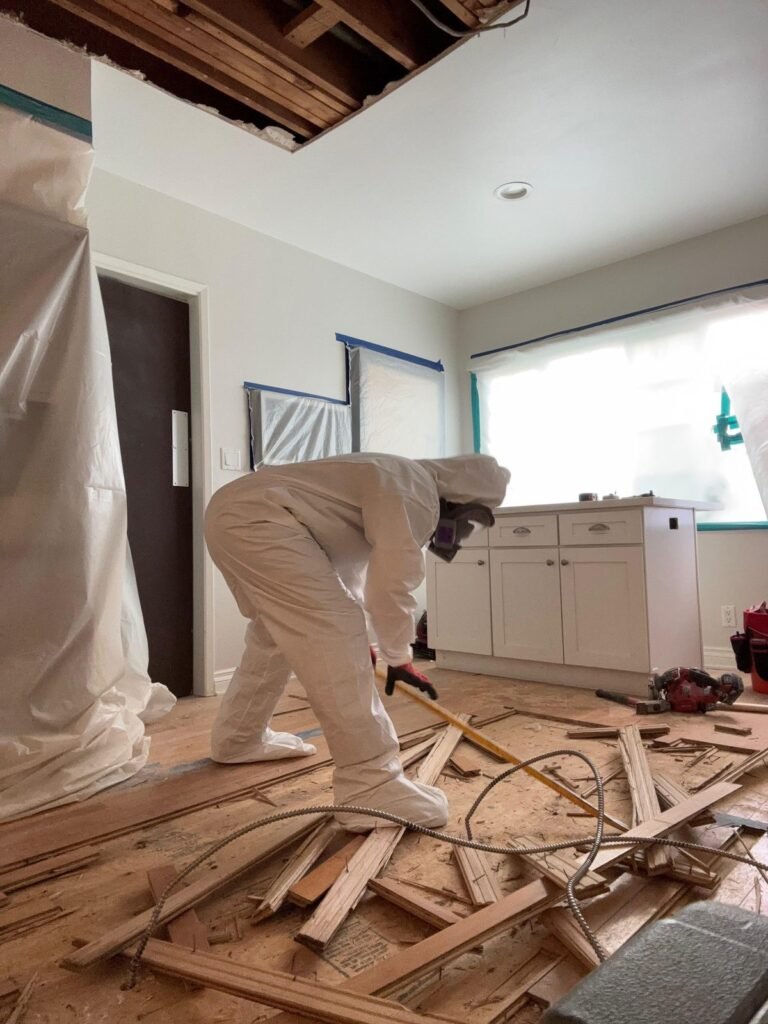
Demolition and drying, then framing, board, texture, trim, cabinets, counters, paint and floor, with the construction half under CSLB #1131134 and the mitigation half under IICRC #70194273. What is worth knowing at the end is whose calendar each remaining date comes off.
Ours we hold. The hour equipment lands, the day walls open, the day the last coat goes on. The rest sit on calendars kept somewhere else entirely, and no contractor moves one of those by sounding certain about it.
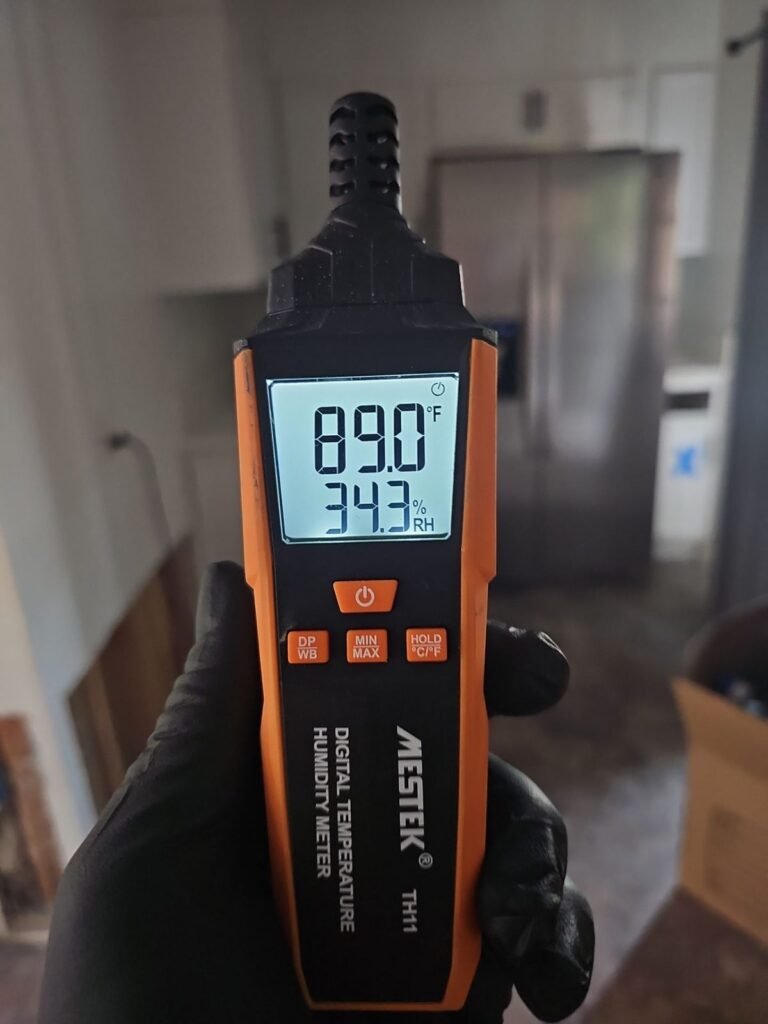
Your insurance company keeps one. What a policy pays, and on what date, is settled inside their office by the adjuster they send, meaning the person the insurer pays to put a number on your loss. Ours is the evidence that gets there fast: dated meter readings for each room, pictures taken while nothing had moved, every piece hauled out itemized with the reason beside it.
A structural engineer keeps another, since past putting back what was already there a drawing has to exist before framers start, and it gets drawn on that engineer’s schedule. The last one belongs to a public counter, and Thousand Oaks has two of those. We book the inspection and stand there for it; what goes on the card is written by the person they send.
The south end of the county, up against the grade. Newbury Park is part of the city, not a separate town, and the wildland edge runs behind a lot of these streets.

Your phone number is the only thing we really need. Everything else just helps us send the right crew with the right equipment.
If a floor in Thousand Oaks is wet, or the hill above Newbury Park just burned, call (805) 427-9039 and our dispatcher will send the crew closest to you. What you want at the end is a house that smells like a house, and a permit card signed by somebody who does not work for us.