The fire is out. What about the rain?
In Ventura County a wildfire is only the first half of the loss. Burned ground turns water away instead of drinking it. The first hard rain pushes ash, rock and mud downhill into houses that never burned. We clean up both halves.
Why does burned ground shed water?
It turns water repellent, and stays that way for years.
The weather office covering this county says it plainly. After a wildfire the soil and the bare slopes repel water for several years.
Roots that held the grade are gone. Leaf litter that slowed a raindrop is gone. Water that would have sunk in now travels across the surface.
It collects ash, sand, gravel and rock on the way down.
Is that the same as mud?
No. Half of it or more is sand-sized or larger.
That size is the line between a debris flow and dirty water. Federal geologists put its speed at up to and beyond thirty-five miles an hour.
Which is why these things take out fences, cars and the low corner of a house. Not a stain on the stucco.
There is no season for it either. Short, hard rain on steep burned ground does it.
How much rain sets one moving?
Less than half an inch, if it lands fast enough.
The Mountain Fire burned close to twenty thousand acres above Somis and Camarillo Heights. Federal hydrologists went basin by basin across roughly thirty-two square miles of burned watershed.
The middle of that range: a quarter of an hour delivering 0.42 inches gives even odds of a flow starting.
0.55 inches over the same fifteen minutes moves the odds to three in four. Stretched across a whole hour, it takes 1.20 inches.
How does that compare off a scar?
Burning a hillside halves the rain it takes to hurt you.
Off a scar, the local forecast office treats about an inch of rain in an hour as its trigger.
On the ground the Springs Fire burned, the figure for that watershed was half an inch.
The Mountain assessment was out twelve days after ignition, before anybody had finished counting what burned.
How many winters does it last?
More than one, and the local record is unkind about it.
A watershed is likeliest to run in the first year. The same federal survey notes that other ground keeps shedding for several years afterward.
The flood side of FEMA puts an outer bound on it. Higher risk until the vegetation grows back, up to five years.
Has Camarillo lived the long version?
Yes, and the sequence there is the one to plan around.
The Springs Fire burned more than twenty-four thousand acres. Eighteen months later, moderate showers ran mud across San Como Lane and damaged two houses.
Six weeks after that, a wall of mud and debris hit Camarillo Springs.
Sixteen houses damaged, ten of them red-tagged, with the mud reaching the roofs. Red-tagged means placarded so nobody could live in them.
That was nineteen months after the flames went out. If you own property in Camarillo, plan around it.
Does a small fire count?
Size is no protection. The Solimar Fire burned 1,388 acres.
Barely two square miles. Mud off that small scar shut lanes of the 101 four times over fourteen months.
County-wide, the federal storm log counts fifty-eight flood and debris flow events over about twelve years. Eleven of them name a burn scar outright.
One entry is almost too neat. It records flash flooding and debris flows on Balcom Canyon Road, and nine months later the Mountain Fire started there.
My house is off the hill. Why care?
The flow does not stop where the slope ends.
It finds a channel and follows it. Here the channels run through the middle of town, not around the edge.
Ojai is the plainest example. Stewart Canyon Channel crosses the city north to south through its center, and Fox Canyon Barranca cuts the eastern third.
Thacher Creek meets San Antonio Creek inside the city limits. The Army Corps built a debris basin at the mouth of Stewart Canyon.
The city’s own plan says the inlet under Daly Road is undersized and can plug with debris.
How often does that town flood?
Ojai’s own plan says once every four years, on average.
The federal claim file for that ZIP agrees. Paid losses in roughly twenty separate years, several of them in Zone X.
Zone X is ground the maps do not call a flood zone at all.
The city of Ventura’s mapped hundred-year ground carries street names too. The river west of the levee, Arundell Barranca below Main Street, Harmon Barranca below Telegraph Road.
How often is it a big one?
One damaging forty homes or more returns every ten to thirteen years.
Federal geologists have run an emergency debris flow assessment for eight fires touching this county.
Small flows arrive almost every year. The large interval is about what this ground keeps for a magnitude 6.7 earthquake.
Mud came through. What happens first?
Nobody shovels until the structure is looked at and photographed.
Debris leaning on an exterior wall weighs far more than it looks. A flow that pushed a wall out of plumb is not a cleaning problem.
If it reached the panel or the outlets, the power stays dead until an electrician says otherwise.
Then the photographs. The height of the mud on every wall of every room, on the doors, on the cabinet toe boards.
That line is the evidence a scope gets built from weeks later, and it vanishes when somebody helpful starts tidying.
Is the material contaminated?
Yes. It carried whatever the watershed was holding.
Ash and burned household debris, fuel off a scorched garage, chemicals off the fields. Whatever a septic system added on the way down came with it.
Gloves and boots, no bare hands, children and pets out of the room.
It also has to come out wet. Debris left to dry sets hard, and hardened silt leaves finish material with a chisel instead of a shovel.
What order does the work run?
Extraction, then the muck-out, then drying, in that sequence.
Muck-out means the wet silt shoveled and scraped out of the building before it can set.
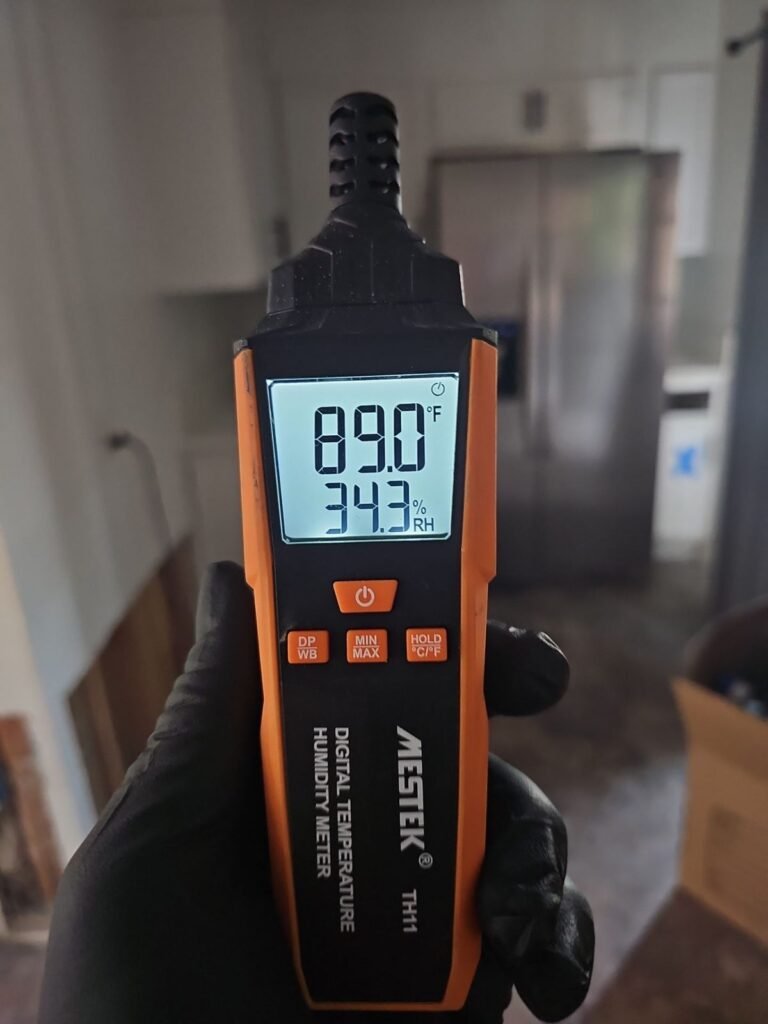
Then removal of whatever is holding water, then air movers and dehumidifiers. Meter readings get written down daily rather than promised.
The drying half runs under IICRC #70194273 and the building half under CSLB #1131134.
How fast does mold start?
One to two days, which is why equipment beats tidying.
EPA guidance is that damp material dried within twenty-four to forty-eight hours usually grows nothing. The same guidance adds that hitting the window is no guarantee.
Some material never gets dried at all. Fiberglass and cellulose insulation and ceiling tiles belong on the discard pile.
Carpet and pad get the one to two day window. Wood needs its moisture pulled immediately.
Once equipment runs, the target is indoor humidity below sixty percent, and thirty to fifty is better.
What does a mud loss add?
Silt still sitting inside the wall cavity.
A cavity packed with saturated mud behind drywall that looks fine will meter dry on the surface. It stays soaked for months.
That feeds exactly the conditions mold removal exists to undo.
On a mud loss the cavities get opened and cleared, not merely dried. That is not a contractor padding a scope.
Does the mud go on the fire claim?
Usually not, and this is where people lose money quietly.
Fire and flow are two events with two causes. They land in different parts of the paperwork even when one winter produced both.
Flood sits outside a standard homeowners policy and always has. It is bought on its own through the federal program.
Inside that coverage sits a distinction worth knowing before anyone disturbs the debris.
FEMA’s own explanation is that mudflow is covered, while earth movement with no flowing character is not.
Why photograph the debris itself?
Because whether the hillside ran or let go can decide payment.
A landslide or a slope failure with no flowing character is the excluded half. So photograph the debris, not only the damage.
The federal government does file both halves under one disaster. Four declarations for this county name fire and debris flows in the same title.
Their incident periods do not close when the flames do. Three of the four run months past the last flame.
Our job is to measure, document and itemize, which is the raw material of a claim.
When you finish, whose numbers remain?
Four, and they belong to other people entirely.
- A structural engineer, if the flow moved something that holds weight up
- An outside laboratory, for material that has to be named not described
- The permit counter, when you want a date rather than an estimate
- Your insurance company, for every question with a dollar sign in it
A racked wall or an undercut footing needs a drawing from a license this company does not hold. Framing waits on it.
We cut the sample and send it. The bench reading it has nothing riding on our invoice.
We file, pay, fix what plan check returns, and stand in the room while the inspector walks it.
Our end is dated readings, pictures taken before a shovel touched the silt, and an itemized record.
What part is not ours?
Debris sitting in the channel behind the lot belongs to the flood control district.
We work from the building line inward. Sediment in the street or the barranca is county work. If mud stopped on the garage slab and nothing porous drank it, a hose and a squeegee close it.
What happens after you leave?
Equipment comes out and the framing goes back.
Bays get insulated, board hung, texture matched, then paint, base, doors and flooring.
What you get back is a finished room under CSLB #1131134. When one winter brought both, our crews take the fire and smoke side too.
It stays one folder from the first shovel to the last coat. The rest of the county questions sit in the guides.
Rebuilding After the Mountain Fire: Permits
Asbestos and Lead Testing, a 1968 Ventura House
Agricultural Runoff: Why Field Water Is Category 3
What you want, when the season is over, is a wall cavity somebody actually opened and cleared instead of dried around.