Almost half of Camarillo went up before 1980, and that decides how a wet wall gets opened.

SOS Restoration of Ventura County takes six kinds of call in Camarillo: a wet floor, a sewage backup, mold behind a wall, smoke and soot after a fire, storm damage, and the rebuild that closes any of them. The county is roughly forty miles end to end, so our nearest crew takes the call. The first visit measures before it prices, and costs nothing. (805) 427-9039.

My pipe burst. Who do I call to shut the water off in Camarillo?

Water extraction underway in a Ventura County hallway after a pipe failure

Start at your own shutoff; that valve is yours whoever bills you.

Past the meter it depends on your block, and this is the only city in the county where that is literally true.

Five separate water providers operate inside these city limits. The city’s Water Division serves roughly 14,000 connections against 27,412 housing units, so about half of Camarillo does not get its water from Camarillo. The rest belongs to Calleguas Municipal Water District, Camrosa Water District, Pleasant Valley Mutual Water Company, or California American Water, and the city lists those four numbers itself.

Which makes the first minute of a main break a map question. If water is rising through pavement rather than out of a wall, the City of Camarillo takes after-hours water emergencies at 805-388-5325. Guess wrong and an hour runs out while you hold for the wrong agency.

Is my address in the city of Camarillo or in unincorporated county?

Settle this before anyone quotes a rebuild, because the postal address lies about it.

Plenty of ground with a Camarillo mailing address sits outside the city limit, and those parcels are permitted by the Ventura County Resource Management Agency, Building and Safety division.

The Mountain Fire made that expensive. It started in Somis in 2024, ran through Camarillo Heights, and Cal Fire closed it at 19,904 acres with 243 structures destroyed and 126 damaged, cause listed as equipment. A large share of that burned ground is unincorporated. One fire, two building departments, and the county says outright that its process only resembles the city’s.

So we check the parcel number against the boundary before a line item gets written. Wrong jurisdiction on page one sends the submittal to the wrong counter.

Wet floor sign placed in a Ventura County hallway while water is removed

How much wall can I replace in Camarillo before the city wants a permit?

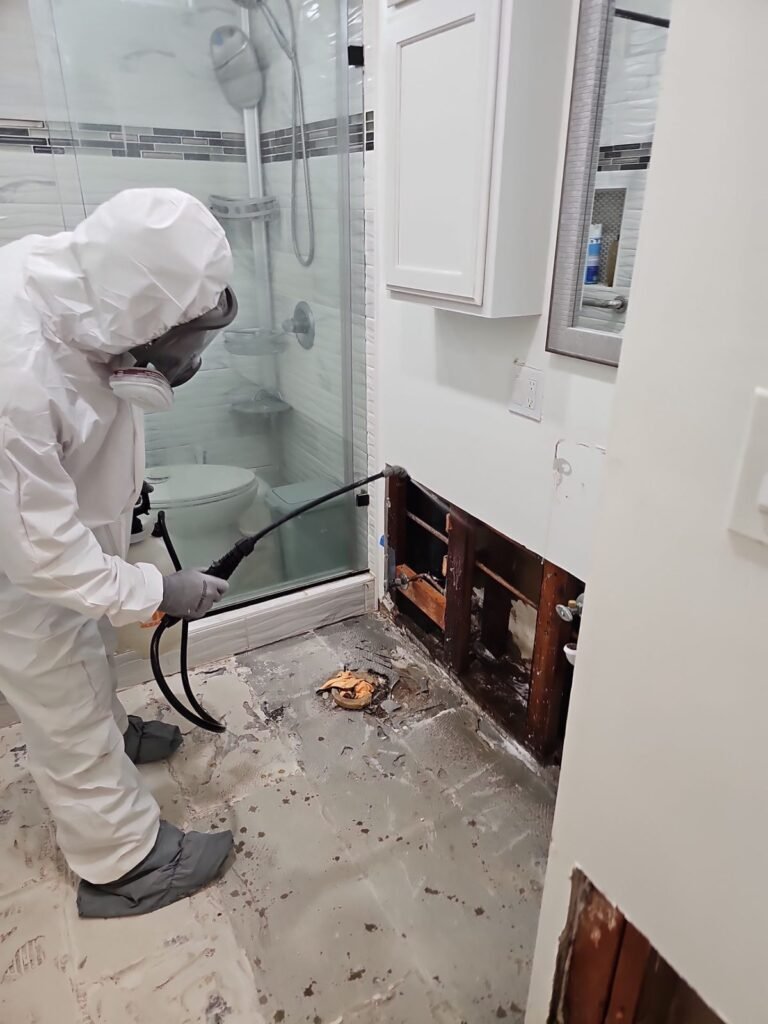
Technician working an opened wall as a Ventura County drying job finishes

Camarillo publishes no square-foot cutoff for drywall, so there is no quantity anybody can point at and call exempt.

A figure circulates online for this county; Camarillo never wrote it down, and anyone quoting it is guessing.

What it publishes instead is an exemption list it deliberately tightened. Chapter 16.04 of the Municipal Code, by Ordinance No. 2034, adopted in 2025, adopts the current California codes including the wildland-urban interface code, then section 16.04.029 cuts two state exemptions down: fences need a permit above 6 feet where the state reference is 7, retaining walls above 3 feet where the state uses 4. Paint, wallpaper, carpet, tile, and cabinets keep the state value. Re-roofing does not, and section 16.04.065 amends roof covering to a minimum Class A rating on every construction type in town.

Paper plan sets stopped being accepted in 2025. Everything goes through the OpenGov portal, with two published surcharges riding on the fees, 17.89 percent for General Plan maintenance and 11.34 percent for technology. The Camarillo Building and Safety Division answers at 805-388-5395, staffed inside City Hall by Charles Abbott Associates under contract, not by city payroll.

Now the part nobody else tells you: the city does not publish a plan review turnaround. No business days, no cycle count, nothing. The clocks it does publish run against you. An application is deemed abandoned 180 days after filing if nobody pursued it, and an issued permit dies if work has not begun inside 12 months or sits idle for 180 days.

My house was built in 1974. Do we have to test before anyone opens a wall?

Assume yes, more often here than anywhere else on this map.

Of 27,412 housing units, 12,731 were finished in 1979 or earlier: 46.4 percent of the city. The 1970s alone account for 7,455 of them, and the median year built citywide is 1982.

The hump has a reason. Camarillo incorporated in 1964 and filled in across that single decade, so its curve looks nothing like its neighbors: median build year 1976 in Oxnard, 1978 in Thousand Oaks, 1980 in Simi Valley. Change the city and the 46.4 percent stops being true. You will read online that this town is full of Craftsman bungalows and 1880s Victorians. Six tenths of one percent of its housing predates 1940.

So almost half the addresses we walk into sit on the wrong side of the lead paint ban and of asbestos leaving building materials. Here that puts a lab result ahead of the demolition on most of the older streets, and what gets sampled before a wall opens lays out the order it happens in.

Baseboards removed and the wall cavity opened to dry a Ventura County living room

Sewage came up in my bathroom. Is that the city's line or mine?

Antimicrobial treatment applied in a sealed hallway after a sewage backup in Ventura County

Do not assume it is your lateral, and do not let anybody else assume it either.

The lateral is the private pipe from your house out to the main, and repairing it falls on the owner. The main does not. Camarillo runs two sewer operators inside one city, the Camarillo Sanitary District and Camrosa Water District, so step one is establishing which of them owns the main under your street. The Sanitary District takes after-hours sewer emergencies at 805-389-4516.

The district put its own condition in writing. Its Wastewater Master Plan, approved in 2022, arrived with a statement from the city that by 2030 the district will have 40 miles of pipe past the end of its useful life. The reclamation plant dates to 1957 and treats around 3.5 million gallons a day. A public network with documented age is why the origin of an overflow deserves an answer.

Whichever pipe failed, the cleanup grade is identical: contaminated water is a removal job before a drying job. What the answer changes is who pays, so the cleanout, the flow direction, and the water line on the wall get photographed before anything moves.

There is mold in my Camarillo condo. Is it mine or the association's?

Frequently both, which is exactly why it turns into an argument.

It comes up here because of how the city is built. Of those 27,412 units, 5,212 are attached single-family homes, a flat 19 percent, and 5,054 more sit inside apartment buildings of five units and up. Nearly one home in five shares a wall, so the water rarely stays where it started. It crosses the party wall and a job that looked like one house becomes two policies and an association.

Renting complicates it. Of 26,068 occupied homes, 9,267 are rented, so in better than a third of these calls whoever opens the door is not whoever signs the authorization or holds the structure policy.

The weather gives mold a longer runway here than people expect. At the Camarillo Airport station the 1991 to 2020 normals put the warmest month at a 73.5 degree high against a 60.6 low, under 13 degrees of spread across a summer day. Normal annual rainfall is 12.93 inches, of which the two hottest months contribute three hundredths. Air that cool and that damp is slow to dry a building, so dehumidification gets sized and metered instead of guessed. Our mitigation side carries IICRC #70194273, and whether you keep living in the house through the work depends on where the growth sits and how containment gets built.

Sealed containment barrier with a zippered door isolating a mold job in Ventura County

My insurance says the repair is over 50 percent of the value. What does that trigger?

Air scrubber running in a Ventura County living room to clear smoke odor

In a mapped flood area it turns a repair into an upgrade, and Camarillo has that threshold in its code.

Chapter 16.34 adopts the city’s Flood Insurance Study with FIRM and FBFM panels 1 through 6 dated 1986, and it defines substantial damage as damage from any cause where restoring the structure reaches 50 percent of its market value beforehand. The same 50 percent governs substantial improvement, and it captures buildings damaged that badly even when the repair never happened.

Cross that line and the building has to reach current standard, raised or flood-proofed, not just put back. FEMA mapping places 705 acres of Camarillo in shallow-flooding Zone AO and 514 acres in the AE floodway, with another 3,625 acres, 28.8 percent of the city’s land, in the 0.2 percent annual chance zone. The Calleguas Creek gauge near town drains 248 square miles and crested at 25,300 cubic feet per second in the storms of 1980.

The city publishes no current panel numbers and no count of properties in the special flood hazard area. It publishes a person to ask: the Director of Engineering Services, its floodplain administrator, at 805-388-5340. Because the answer swings the scope, we settle it before pricing the reconstruction, which our construction side runs under CSLB #1131134 as one written total, agreed and signed while the walls are still open.

Mud came in the back door after the rain. Is that the same as a water job?

It is not, and Camarillo has the record to prove it.

The Springs Fire burned more than 24,000 acres above town in 2013, and the mud arrived nineteen months later. In that storm the Camarillo Adohr gauge measured six tenths of an inch of rain in ten minutes; sixteen homes in Camarillo Springs were damaged and ten were red-tagged, which is the placard that says nobody sleeps there until somebody signs it off. Weeks before that, moderate showers alone pushed mud waist-deep down a street there.

The threshold is the number that matters. Over that burn scar the U.S. Geological Survey set the debris flow trigger at half an inch of rain per hour. Off burned ground, the Weather Service office covering this county works from a full inch. Burning the hillside halves the rain it takes.

The same air that holds a summer afternoon at 73 degrees turns twice a year. The day the Mountain Fire started, the Weather Service issued a Particularly Dangerous Situation red flag warning for these valleys and this coast: humidity forecast at 8 to 15 percent, gusts of 50 to 70 miles an hour. That is one side of the cycle; mud is the other.

Debris is a removal problem first. Mud and rock load a floor system, carry contamination, and pack into cavities no fan will reach, so nothing dries until the volume is out. Different opening move than a clean supply line failure, which is why we ask what came through the door.

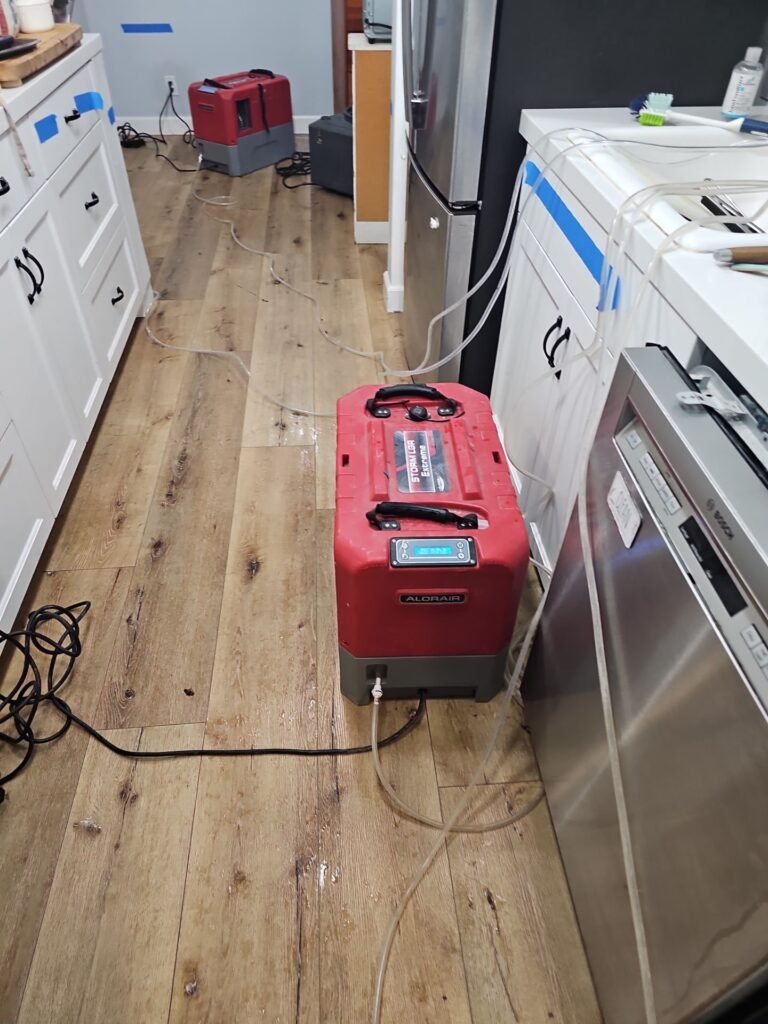
Moisture meter reading taken on a vinyl plank floor in a Ventura County home

What happens after you leave?

One room, finished, and a folder.

The room is the easy half: framing, insulation, board and texture, paint, doors and trim, cabinets, counters, floor, all of it inside the contract that started with the demolition. The folder is the half worth explaining. It is the paperwork your insurance company sits down and reads before it decides what your loss is worth, which is why the original stays in your hands and not in ours.

The readings and the photographs. Every affected room metered day after day, pictures shot before the first stick of baseboard came off, and a written tally of what went in the dumpster. Keep the original. A copy travels to your insurance company, and the figure they eventually put on your loss is reached by their people, on their side of the table.

The laboratory report, common in a town built this early. It arrives carrying a chain of custody, the name of the analyst who read it, and an accreditation number belonging to the lab rather than to us, and that distance is the whole value of the page. We take the sample and drive it over. Material nobody sampled stays a blank in the folder rather than a conclusion in it.

The stamped sheet, and the permit card. Where the loss took out something holding weight, the drawing leaves a California engineer’s office with a license number under the seal, and our crews cut lumber to what it shows. On the card, ours is the application, the fee through the portal, the inspection slot, and standing there while the work gets walked; the initials in the boxes come from Camarillo Building and Safety inside the line, or Ventura County Building and Safety outside it. Whose pen that turns out to be was settled the day we checked your parcel against the boundary.

Wet, burned, or backing up at the moment, the number is (805) 427-9039, and our dispatcher takes the address in English or Spanish before the nearest crew loads. If it can hold, send photographs and a parcel number through the contact page and the same crew reads them, because SOS Restoration of Ventura County works Camarillo from the burn scar down to the flats.

Water damage

Water damage restoration across Ventura County, open 24 hours: extraction, drying, and dated readings until the house holds dry. Call (805) 427-9039.

Mold

Mold removal and inspection in Ventura County, CA. The order the work happens in, what gets torn out, and how dry is dry. Call (805) 427-9039, any hour.

Fire & smoke

Fire and smoke damage restoration across Ventura County: soot, odor, board-up, drying, and the rebuild after. Call (805) 427-9039, open 24 hours.

Storm damage

Storm and debris flow damage in Ventura County: water and mud out, the structure dried on meter readings, rooms rebuilt. Open 24 hours, (805) 427-9039.

Sewage cleanup

Sewage backup cleanup in Ventura County: what leaves the house, how we measure the wet line, and who puts the room back. Call (805) 427-9039, day or night.

Reconstruction

We rebuild what the loss took out across Ventura County: framing to final paint, one fixed written price, permits filed. CSLB #1131134. Call (805) 427-9039.

Where our crews go

Camarillo sits between the Calleguas drainage and the hills the Mountain Fire came over in 2024, which is why the rebuild work here has not slowed down.

Can't call right now? Send it and we call you.

Your phone number is the only thing we really need. Everything else just helps us send the right crew with the right equipment.

Camarillo sits between a burn scar and a floodplain, so the first thing our dispatcher settles is which side of the city line your parcel is on. Call (805) 427-9039. What you are paying for is the morning the last machine leaves your floor, the parcel question answered on paper, and a room the next red flag day can blow past without you thinking about it.