SOS Restoration of Ventura County works water losses in Oxnard, Ventura, Camarillo, Thousand Oaks, Simi Valley and every other town in the county. We pull the water, open what soaked, set drying equipment, and log the numbers each day until they stop moving. Open 24 hours: (805) 427-9039. Coming out to look costs nothing.
The first twenty minutes are diagnosis, not demolition.
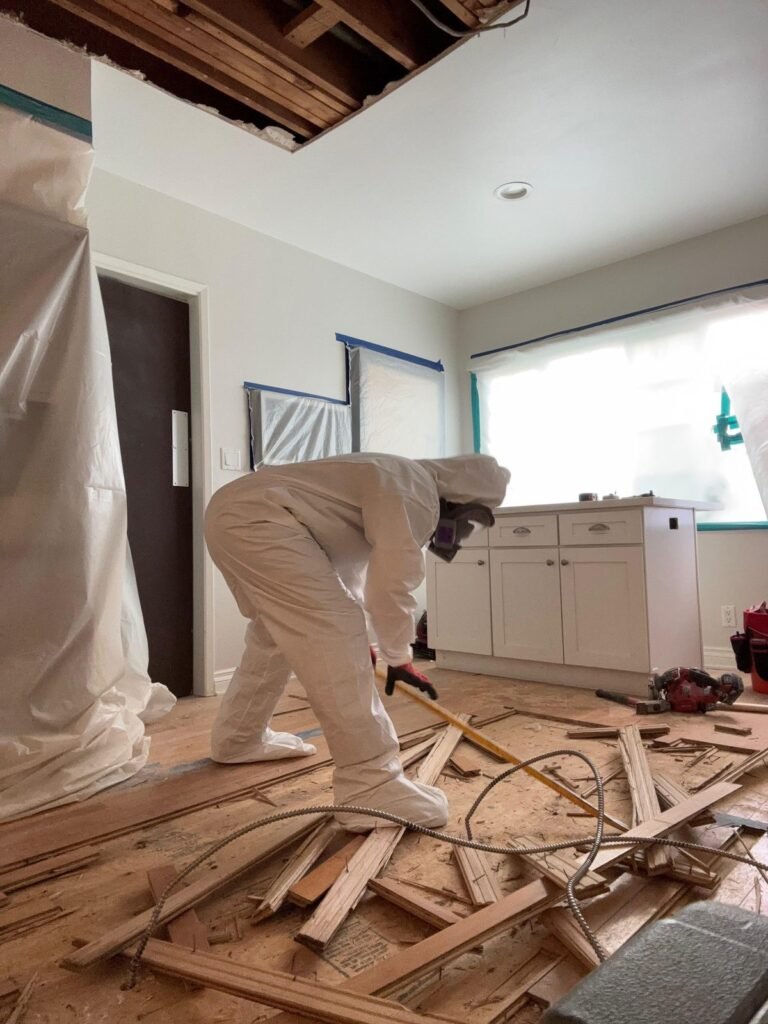
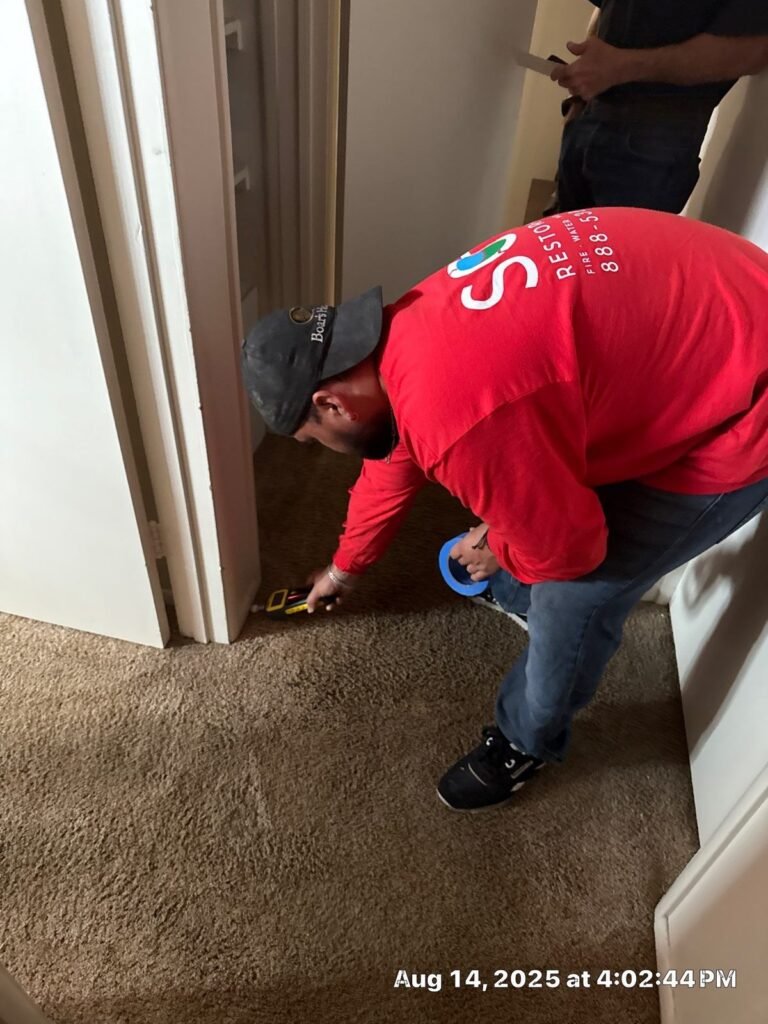
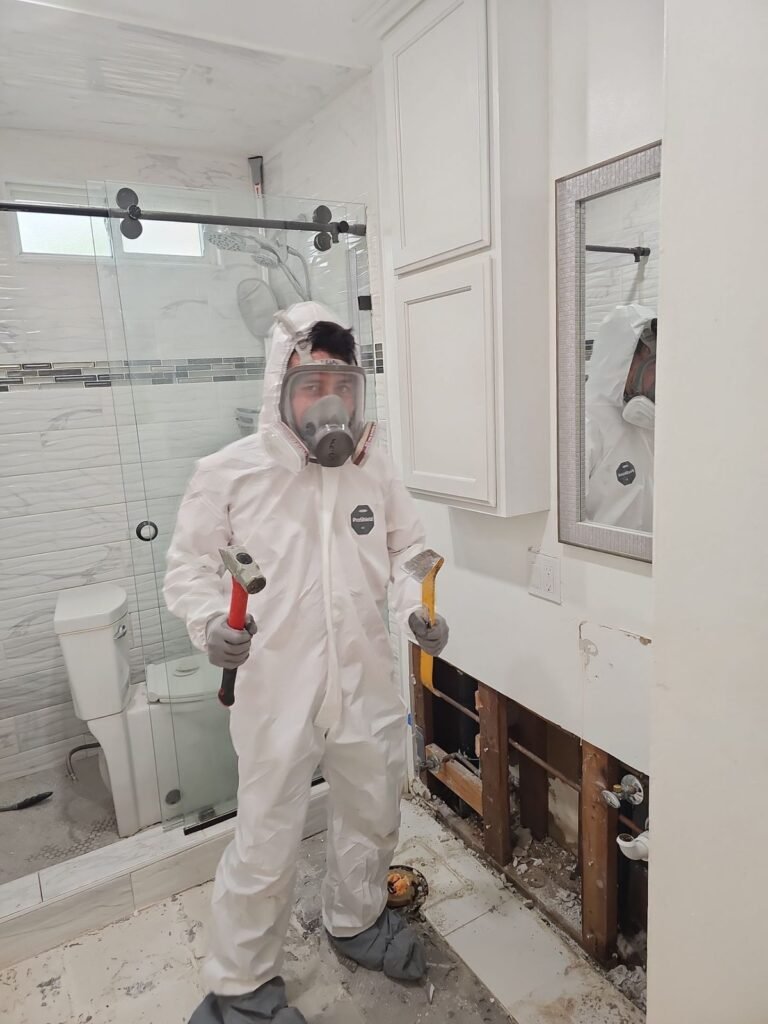
The crew chief confirms the source is shut off, then walks the perimeter with a meter until the wet edge shows itself, and that edge is almost never where the stain stops. Then the standing water comes out. Then the material that will not dry gets opened. Then the machines go in.
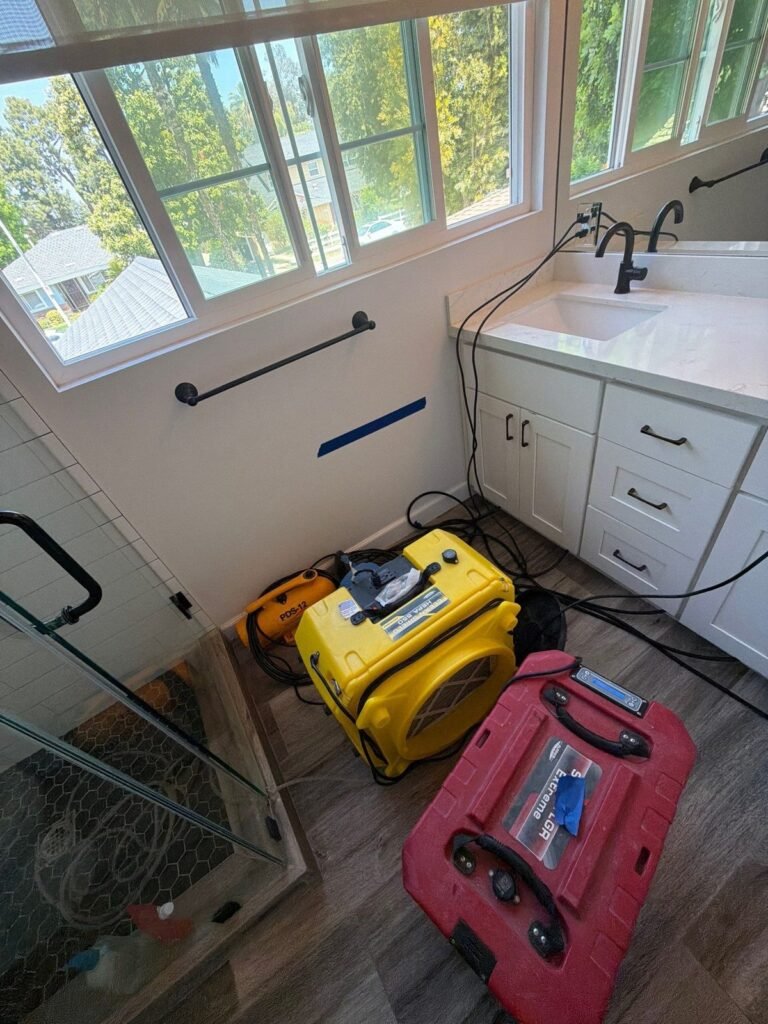
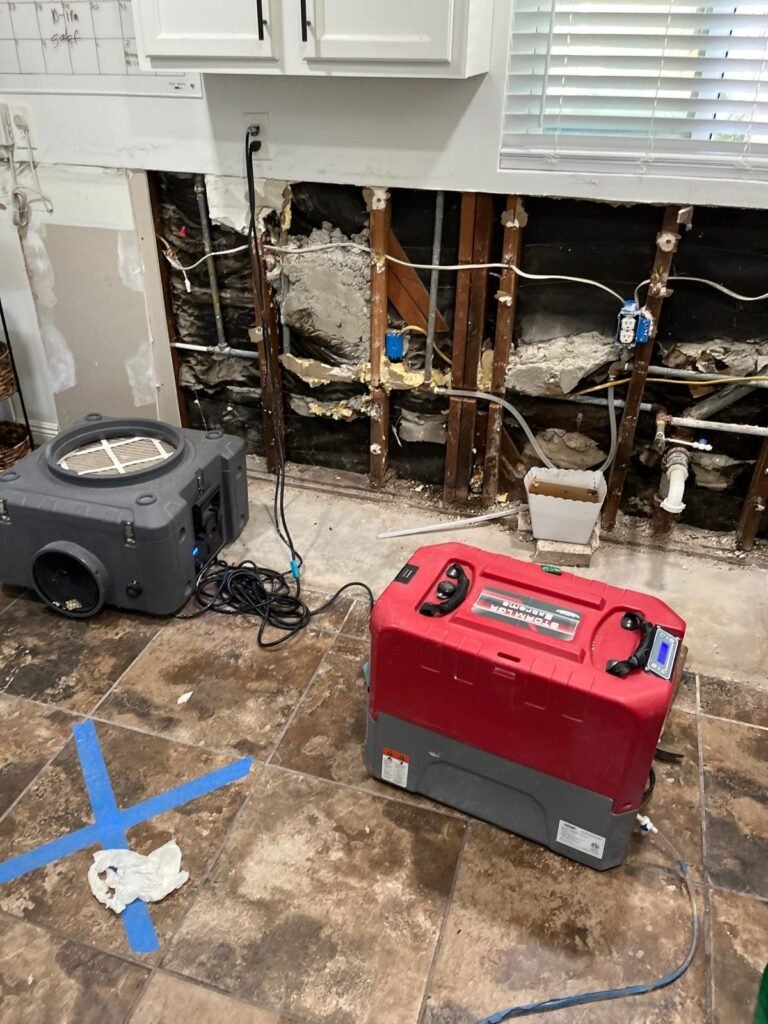
What you get out of that is a case folder, the document a stranger at your insurance company has to be convinced by. Every wall that reads wet gets a number written against it, every machine is logged by where it sat and the hours it stayed, and the room is photographed before a crew touches anything in it. Our people work in English and Spanish, on houses and on commercial buildings, and the readings go into that folder the same way whether the loss is a laundry closet or a warehouse floor.
Eight of the twelve Ventura County restoration pages that rank for this search publish no license number anywhere on them. Ours are CSLB #1131134 on the construction side and IICRC #70194273 on the mitigation side, and you should ask the same of everyone else you call.
Probably not, and a federal number is the reason.
The EPA puts it in writing: if wet materials are dried 24 to 48 hours after a leak or spill, in most cases mold will not grow. That window is the whole argument for treating a wet floor as a right-now problem rather than a next-week one.
The same guidance carries the honest half of it. Even when materials get dried inside 48 hours, growth may already have started, which is why nobody who knows this work will tell you over the phone that you are fine. A meter says that, and only after somebody has held it against your wall.
Part of that is a judgment call and part of it was settled years ago by a federal table.
Soaked cellulose and fiberglass insulation and wet ceiling tiles sit on the discard-and-replace side of the EPA’s own table: they hold water, they will not give it back on any schedule you can work with, and a fan pointed at them is theater. Carpet and the pad under it get a 24 to 48 hour window, and past that the pad usually loses. Wood has the moisture taken off it immediately, because wood left wet cups, then swells, then splits.
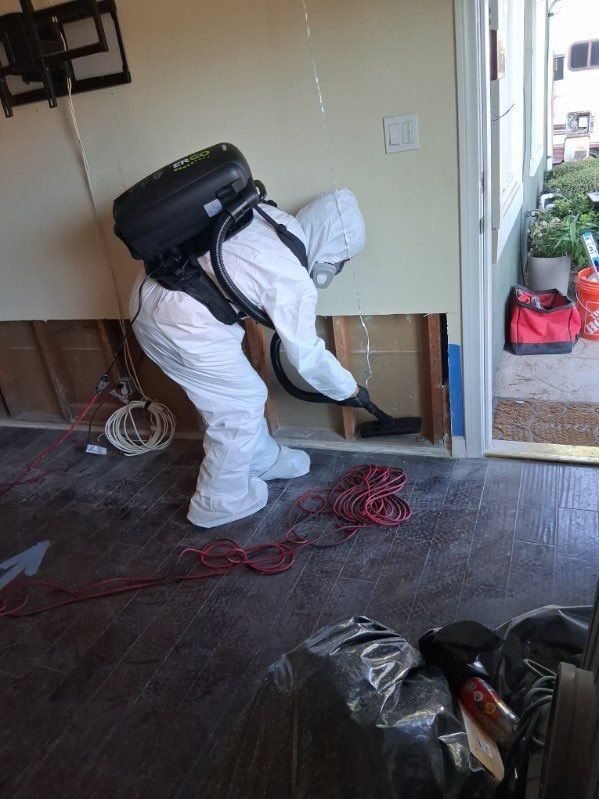
Drywall is where people argue with us. Sometimes it dries in place with the baseboard pulled and air moving behind it, and sometimes it has wicked high enough that the only clean move is to cut a straight line and take the bottom out. In an older house that saw stays in its case until the sample comes back, and what has to be tested first covers why. We would rather show you the reading and let you watch the decision get made than hand you an opinion.
Cabinets are the quiet loss. A box built from particleboard swells from the bottom rail up and never comes back to square, so the kick and the base go long before the doors do. Solid wood usually survives if somebody gets under it fast, which is one more argument for calling before you start moving furniture around.
Because dry is a number here, not a feeling.
The EPA target for indoor air is under 60 percent relative humidity, ideally between 30 and 50 percent, and the structure has to come back down to whatever the same material reads in a part of the house the water did not get to. That second reading is the control, and it is why we take one from an untouched closet on day one.
Equipment stays until the readings stop falling and then hold for two straight days. Not because the machines were booked for a week, and not because a hand on the wall says so. Plaster over lath in an older Ventura or Santa Paula house will read high for days after a newer wall has finished, and that is the material behaving normally, not a second problem.
The log matters more than it looks. It is a dated column of figures, room by room, and it is the only thing that can settle the argument that shows up two months later about whether a wall was dry on the day somebody closed it.
Nobody rebuilds that from memory, and a photograph of a fan on a floor proves nothing at all.
Three reasons, and only one of them is weather.
The first is plumbing arithmetic. Oxnard delivers drinking water through 42,804 service connections to roughly 200,232 people, and the city of Ventura through 28,954 connections to 113,500. Every one of those is a line with joints in it, and joints are the part that fails.
The second is the ground itself. FEMA maps 124 acres inside Santa Paula as shallow flooding, with declared depths of one, two and three feet, and another 264 acres as regulatory floodway, about 7.2 percent of the city. Water that already has a mapped depth is water somebody was expecting.
The third is what a genuine storm does to everything at the same time. Across two days of the 2023 storms the Ojai Valley Sanitary District reported 5.4 million gallons on the first and 5.6 million on the second, both logged as natural disaster: eleven million gallons in forty-eight hours. Fillmore put out 109,985 gallons from one failed pipe that same year. In a storm like that the call volume is not the hard part. The hard part is that every house in the county starts its emergency in the same hour.
The drying half runs on an hourly meter and the building half arrives as one closed figure.
Drying is billed by the hour and starts at $61 an hour. The honest answer to “how much” is that it moves with how many rooms are wet, how many machines the drying takes, and how many days go by before the meters settle. One wet bathroom and a slab leak under half a house are not the same invoice. The full rate card sits on the cost page, in a table, with what each rate covers.
The rebuild half does not work that way, and that is law rather than preference. State law will not recognize a home improvement agreement here unless a dollar total is written on its face, so reconstruction arrives as one agreed figure, settled the day the scope is written. Nobody can produce that number over the phone, which is why the technician on site comes out first. He walks the rooms with a meter, tells you which materials are wet and which only look it, and leaves that list with you.
No charge for the visit and no obligation waiting at the end of it.
Less than most people brace for, because both halves are ours.
Once the structure reads dry, the same crew frames, insulates, hangs and tapes board, matches the texture, paints, and sets trim, doors, cabinets, counters and floors until nothing in there says anything happened to it. Two pieces of paper, one company: hours on the drying side, a closed figure on the building side.
Ask the same thing of anybody else you call. One contract or two, and who is holding the second. Not one of the twelve county pages we read for this search says out loud that the outfit drying your house may have no way to put it back together.
Now the part nobody mentions in advance. Three questions are going to land on you inside the next few weeks, from a carrier, from a neighbor who went through this last winter, from whoever buys the house in six years. Have the short answers ready.
“So you decide what the insurance pays?” No. Your carrier decides, and what it decides on is the case folder, which is the part that is ours: readings with dates on them, photographs shot before anything got moved, and an itemized record of what came out of the house and why. Anybody who tells you on night one what will be covered is guessing out loud in your kitchen.
“Who signed off on that wall?” A building inspector did, on a dated line nobody at this company is allowed to sign. Our part is filing the permit, calling each inspection in order, and standing there while the work gets walked. Whether it passes that morning is the code official’s call, and that is precisely the answer a buyer’s agent wants to hear six years from now.
“Did an engineer look at this?” Only if the damage reached something the house leans on. Putting back what the water ruined is ours, first cut to last coat. Past that line, a joist or a post or a footing gets drawn and signed by an engineer before anyone builds it, and the crew follows that drawing to the fastener.
Three questions, three short answers, none of them the sort you want to be improvising at a kitchen table. And if something turns up months from now, long after the last fan left the hallway, send it over anyway.
Water runs downhill and this county has two drainages that decide where it ends up: the Santa Clara River through the farm towns, and the Calleguas through the inland valleys. We work the whole map, coast to backcountry, and the drive to the far side is not a reason to say no.

Your phone number is the only thing we really need. Everything else just helps us send the right crew with the right equipment.
Call (805) 427-9039 the hour it happens, whatever hour that turns out to be, and the last thing you will do on this job is stand in a finished room reading a meter that has not moved in days.