
What SOS Restoration of Ventura County is, and what it is not

SOS Restoration of Ventura County works both halves of a loss: the emergency end, where water, fire, smoke, mold, storm damage or sewage gets stopped and dried out, and the rebuild that follows it. From Oxnard out to all ten cities of the county and the ground between them, (805) 427-9039 is answered at any hour.
What does this company actually do?

Wet floor sign placed in a Ventura County hallway while water is removed

Two jobs that most people meet as one bad week.

The first is mitigation, the ugly and urgent half: shutting off whatever is still arriving, pulling standing water out, setting equipment, cleaning soot or sewage, and hauling away the carpet pad, the wet insulation and the board that will never be right again. The second is putting the rooms back. Studs and insulation, new drywall, texture matched to whatever survived, paint, trim, doors, cabinets, counters, floors.

Houses, apartments, offices, restaurants, warehouses. A leak under a sink and a burned kitchen are the same trade at different volumes.

Why the first call cannot wait has a clock behind it. Federal guidance puts the window at 24 to 48 hours: material dried inside it usually will not grow mold, and past it the discussion turns from drying to demolition. That is the case for calling a stranger the hour it happens instead of the day after. What our dispatcher does with that call is pull the nearest crew toward you while the window is still open, which is the only part of that hour anybody can actually change.

Coming out to look costs nothing. The technician on site reads the walls and the subfloor with a meter, says what is wet and how far it traveled, and writes it down. Take those numbers and hire your brother-in-law if you want. They are yours.

How far do you come, and where does the county end?

The boundary is the county, not a distance.

Oxnard, Ventura, Camarillo, Thousand Oaks, Simi Valley, Moorpark, Port Hueneme, Santa Paula, Fillmore and Ojai are the ten incorporated cities, and there is no eleventh. Unincorporated ground counts too: Somis, Piru, El Rio, Oak View, Meiners Oaks, the ranch roads off the 126 and the canyons behind them. Newbury Park is a neighborhood of Thousand Oaks rather than a town, and we work it as one.

You will not find a mileage promise here. Forty-odd miles of coast, farm valley and mountain sit inside that line, and what our nearest crew actually needs to reach Ojai with the road running water has nothing to do with a circle on a map.

Covering the whole county is not a marketing decision. It is what this ground asks for. Federal geologists have run emergency debris-flow assessments on eight separate fires touching Ventura County over the past decade, the earliest of them in 2015, and on the Mountain Fire scar above Camarillo their modeling puts a coin-flip chance of a flow at 0.42 inches of rain in fifteen minutes. The Sandy Fire scar, 2,183 acres beside Simi Valley, is facing its first wet season at a third of an inch. FEMA holds that risk open for up to five years after a wildfire. Fire, then rain, then a hillside in somebody’s living room, then mold behind the board three weeks later. One county, one sequence, one crew that has stood in each stage of it.

Drywall cut back to sound material during a mold removal in Ventura County

How do I check you are real before I let you in?

Technician working an opened wall as a Ventura County drying job finishes

Both halves of this trade carry a number you can look up from your own phone in under a minute.

Do it from your own phone rather than from a card somebody hands you. The construction side is CSLB #1131134 with the state board, and the mitigation side is IICRC #70194273. Both are searchable, and anyone who will not read you the digits has answered a different question.

Make it your first filter, because it eliminates fast. State law has required the license number, ours is CSLB #1131134, in every form of advertising since 1973, and the regulation counts any electronic transmission, meaning a website exactly like this one. Of the twelve restoration pages ranking for this county’s searches today, eight show no number anywhere, footer included.

Classification matters as well, and nobody local explains it. Rebuilding a damaged home falls under California’s general building classification, which turns on a structure needing at least two unrelated trades, and the code is specific that framing and carpentry do not count toward the two. A crew that can frame and hang board is not automatically able to contract your rebuild. Ask what the number carries before anyone quotes a house.

Two more, worth asking anyone: your own people or subs, and will the daily readings be written where the owner can see them?

Why is there no street address on this website?

Because there is nothing here you would need to drive to.

The listing keeps the address off the map on purpose, the equipment lives on trucks, and every hour that matters gets worked at your property. A showroom is for choosing door styles, and nobody books one with a ceiling coming down.

Hours, the phone and a way to send photos are what people actually want, and those are on the contact page. Every service is laid out from the home page if you would rather read before talking to anyone.

Do you dry it out and then hand me off to somebody else?

No. Whoever opens the drywall in your house is who puts it back.

That handoff is the worst moment in this industry, and carrying both halves is why it does not happen here. Everything lands in one case folder: pictures shot before a single thing got moved, the moisture numbers logged day by day, and an itemized account of what left the property. Your carrier decides the money off that folder, so it has no business being re-explained to an outfit that was not in the hallway on night one. How that half runs is on the rebuild page.

It also means nobody puts a saw into a wall in a house of a certain age until the sample has come back, and what has to be tested first lays out that order.

What does it cost to have somebody come out?

Nothing, and it is not a coupon.

The technician on site shows up with a meter and tells you straight which materials are holding water. No invoice follows, and nothing about it ties you to us.

After that the two halves are priced in two different ways, and the difference is legal rather than stylistic. Mitigation labor is billed by the hour, starting at $61 an hour and moving with the work in front of it, because no honest flat sum exists for a structure whose insides are still unknown on night one. Every rate sits on the cost page, published where you can read it before dialing.

The rebuild goes the opposite way. A home improvement contract in California has to carry its price written out in dollars and cents, signed before work starts, so a rebuild sold by the hour is not a legal agreement here. You get one written figure, agreed first. What moves that figure is on the rebuild cost page, and it beats any average you will find online.

Is there anybody who speaks Spanish?

Yes, on the phone and on the crews.

Nobody should be hunting for vocabulary while water runs down a hallway.

There is a paper side that matters more than the courtesy. When a home is damaged in a disaster with an emergency declared, the repair contract must carry a cancellation notice good for seven business days, set in bold, sitting next to where you sign. The law also says that notice has to appear in the same language used in the spoken sales pitch, and the statute names Spanish outright. So if a man pitched your abuela in Spanish and left an English form on the counter, that contract has a defect in it. True whether the company on that contract is ours or not.

Which of these do I not need to hire anybody for?

Five situations, and each one has a number or an owner behind it.

  • A small patch of mold with the leak already fixed. The federal do-it-yourself line is ten square feet, a patch roughly three feet square. Below it, if the surface is hard and the leak is already dead, wipe the spot down and keep your money. Anything bigger, or anything living inside a wall, belongs on the mold page.
  • Water that has not stopped. A live supply line is a plumber’s call, a hole in the roof is a roofer’s. Drying against a source still running is money burned in front of you.
  • You rent. Tell the owner or the manager in writing today, with dated photos. They hold the policy and they authorize the work, and a tenant who hires on his own often ends up with a bill no carrier will read.
  • You are on the far side of the county line. Ours is Ventura County. Past it, a company based on that side gets to you sooner, and sooner is the whole game.
  • The kitchen you were already planning to redo. If the damage did not cause it, it is not part of this job. Separate conversation, separate contract, and we will say so rather than quietly fold it in.

Timing is the last one. If the house is dry and what is left is a question rather than an emergency, read first and call second. The insurance claim page and the FAQ cover most of what reaches the phone at eleven at night.

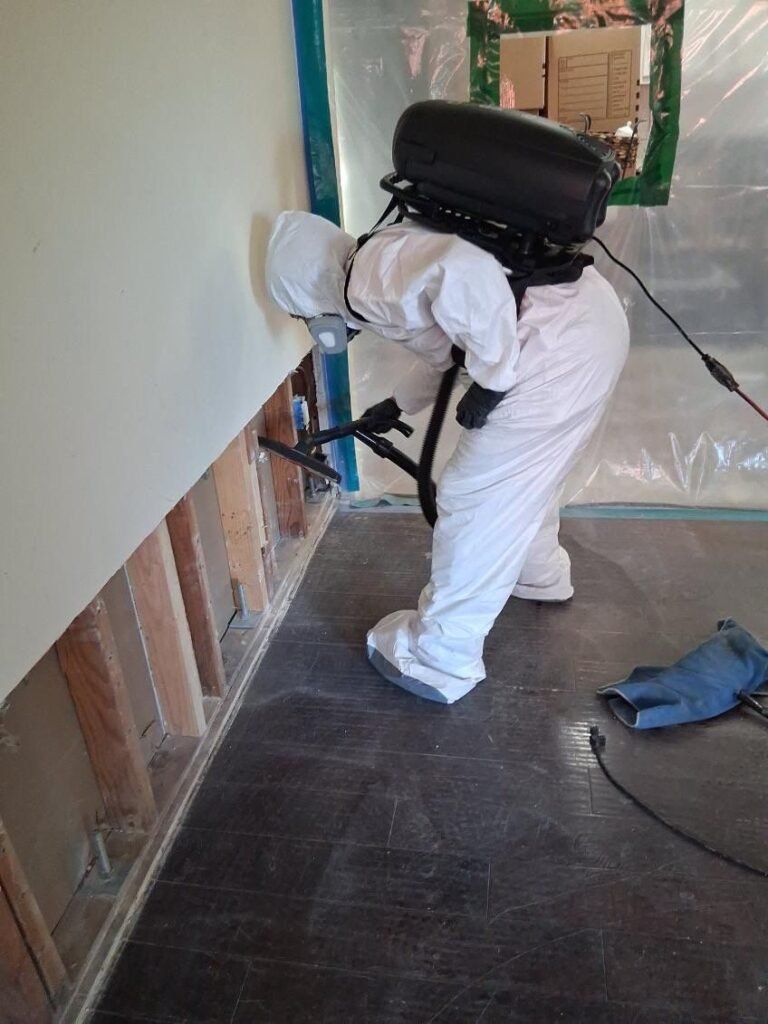
Technician in full protective gear sealing containment plastic during a mold remediation in Ventura County

So what do you tell me at the door on the last day?

That it is over, and that the meter says so rather than the crew.

The readings held at dry for days, not hours. Ruined material is off the property and accounted for, the board is up, the texture matches, the paint is on. You walk it with the crew chief who has stood in your hallway since the first night, and the punch list, the short page of everything still not right, is yours to write rather than ours. Then the shorter half: three calls on your house are not made by anybody who works here.

Your claim is answered by your insurance company. You submit it, and the adjuster they send rules on it. What this crew leaves you is evidence: dated readings room by room, photographs taken before a hand touched anything, and an accounting of every ruined piece that left the property, with the reason written next to it. Water that arrived from outside rather than out of a pipe is flood, which the standard homeowners form leaves out, so read that page of your policy while the house is still dry. Of every five flood claims this county has ever collected, two were on ground the maps rate low risk.

Anything past putting the house back as it stood gets drawn by an engineer, and the finished work signed by an inspector. Like for like is our trade. Once a beam, a post or a footing is in question, the fix comes off an engineer’s desk with a stamp on it, and our part narrows to executing that drawing. That last signature belongs to whoever the city or the county sends out, and nobody in a work truck can promise you how it goes.

Whatever needs a name put on it goes to a laboratory. An independent hand pulls the sample and the lab issues the finding, whichever way it reads. Setting that up, and building to what it calls for, is ours. Our word on material nobody tested is worth nothing to you.

Can't call right now? Send it and we call you.

Your phone number is the only thing we really need. Everything else just helps us send the right crew with the right equipment.

The last thing that happens on a job like this is a slow walk through a finished room with nothing left to point at. Call (805) 427-9039 and tell our dispatcher which Ventura County town you are standing in.