
A garage that smells musty in Oxnard at the height of summer is usually reading the air. It smells fine in the rainy season, and that is the tell. Not a broken pipe. This separates the two, and says when it becomes mold work.
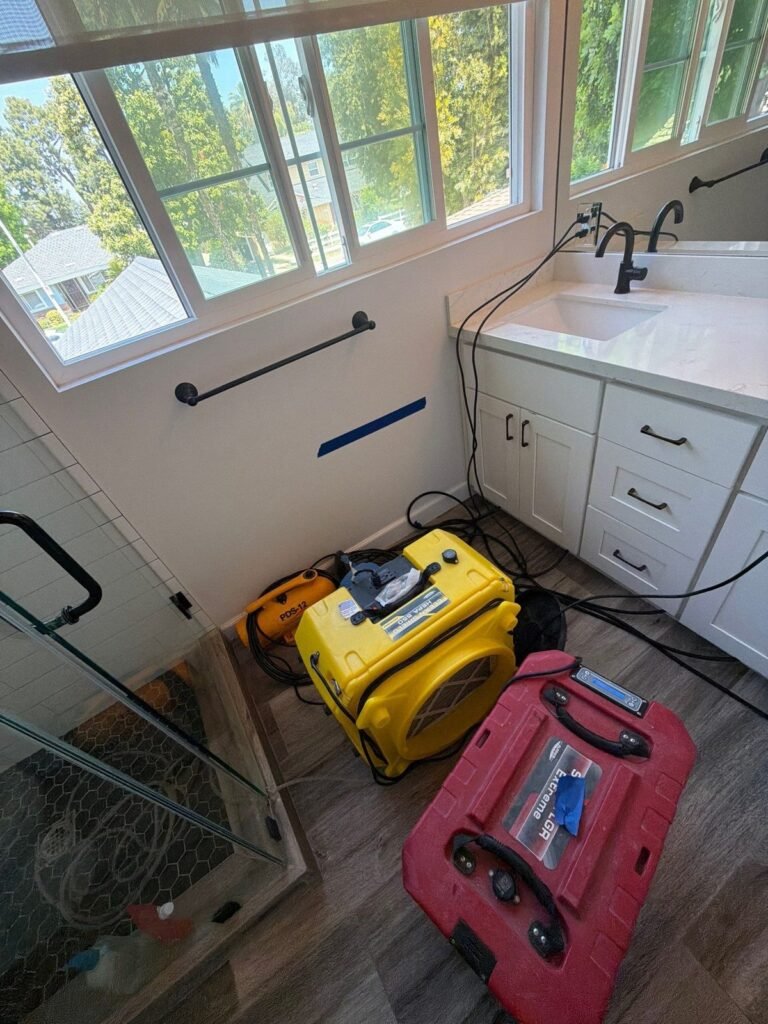
The smell follows your slab against the air, not rain.
A normal year in Oxnard brings 12.93 inches of rain. The three summer months contribute 0.11 inches between them.
The garage is at its worst in the season when nothing falls on the roof. Whatever is wetting that room in summer came off the ocean.
Summer air here arrives close to carrying all the moisture it can hold. It walks in under the door and around the jamb.
It stays near the temperature of the ground beneath it.
Out here that holds in the low sixties year round. Put damp air against a surface that cool and the air gives up water.
No drip, usually no puddle. Just a film on the coldest low surfaces that never quite finishes leaving.
The wet season reverses both halves. Cold air holds less water by weight, so the same gray sky delivers a fraction of the load.
The slab is now often the warmer surface, so the traffic runs the other way.
Often, and that contradiction is the useful part.
Add the offshore wind events that push genuinely dry air across the county for days at a time.
It rains, and the garage smells better.
Wet enough that this coast has no drying afternoon.
The Oxnard normals put the average daily temperature swing at 15.9 degrees. They count 2.4 days a year that reach 90, with the warmest month topping out at 73.5.
Read that as a building, not as weather. No hot, thirsty part of the day ever arrives to pull moisture out of your shelving.
The air spends the summer in a narrow, damp band.
A little better, five miles from Port Hueneme.
The nearest official station reads a mean annual high of 69.1 degrees, with an average daily swing of 17.9.
Ten miles inland at the Camarillo airport that swing is 21.0. Two degrees sounds like nothing until you count a hundred afternoons.
That station also collects 12.53 inches a year over about 19 wet days. Only 3.3 of those bring an inch or more, and four months carry 81 percent of it.
The rain is concentrated, brief, and in the wrong season to explain a summer smell.
Not the concrete. Concrete has no odor.
What smells is the organic material resting on it and leaning against it.
Corrugated board pulls moisture out of a cool surface by contact and holds it. The glue between its layers is food.
The drywall band that matters is the last twelve to eighteen inches above the slab.
That is why the smell so often has no visible source. You are smelling square feet of cellulose that has been damp on and off since the fog set in.
Four tests, and three you can run yourself.
Weather-driven damp has hours and a season. A leak reads no calendar.
If a cold wet afternoon smells the same as a hot summer morning, stop blaming the ocean.
Geometry. Coastal damp has none.
Coastal damp spreads evenly and settles at the lowest, coolest surfaces across the whole floor.
A leak has a fan across the slab from one corner. Or a band tracking a pipe, or a cone under a roof valley.
If you can draw an arrow back toward a point, that is not the marine layer.
One in the garage, one in a far bedroom.
Read both at the same hour for a week. A garage running well above the rest of the house on dry days has a source inside it.
A garage that tracks the outdoor air is just a garage.
Then shut the door and run a dehumidifier for two full days, watching the pail. Weather damp surrenders and the smell drops off.
A source refills the room while the machine runs, and day two fills as fast as day one.
Yes, and it belongs to the storms, not the summer.
On the three or four days a year that bring an inch of rain, watch the driveway. One pitched the wrong way puts a sheet of water under the door.
It leaves a dirt line at the entry and a stain that thins going back.
Different problem, different fix, and it will not smell in the dry months.
Only at the right hour, and most people pick wrong.
Rolling the door up on an overcast morning invites in air already carrying about as much water as it can.
That is not ventilation, that is delivery. The slab condenses the fresh charge, and the problem has simply moved three feet.
If you are going to open it, do it late on a day that actually cleared. Give it two or three hours and shut it before the evening air comes down.
A dehumidifier in a sealed box, and shelving.
That machine fights a sealed box and wins. Against an open door it is an expensive fan.
Then do the boring thing that outperforms all of it. Get everything off the slab.
Two inches of air under a box beats any spray, deodorizer or candle. Wire shelving, a couple of pallets, a rack along the back wall.
Swap cardboard for lidded bins as they empty, and leave a hand’s width behind the stacks.
Three reasons, and they stack on each other.
The ground is first. Port Hueneme sits on the Oxnard Plain at about eleven feet above sea level.
Its own environmental review calls the sand and silt saturated across the entire city limits. Cool, damp ground keeps a slab cool and damp.
With no crawl space in between to buffer it. The building is second, and roughly seven in ten homes there went up before 1980.
The median year is 1974, and only about a third are detached houses standing alone.
Often the person actually smelling it, which is the delay.
Nearly another third share a wall, against roughly two thirds freestanding county-wide. So the damp may not have started on your side.
More than half the occupied homes there are rented. Opening the wall belongs to an association or an owner living somewhere else.
When a tenant calls, the first useful thing is usually a written reading to forward, not a crew.
A garage in Camarillo dries itself every afternoon.
It gets that wider daily swing and a real afternoon, which dries the room for free.
Same county, same ocean, a different drying problem.
Three signals, and any one of them is enough.
Wiping sealed concrete is housekeeping. Wiping the paper on wallboard is not.
The reading that counts comes off the same meter, two days after the equipment shut off.
Read the walls, seal the room, pull what cannot return.
Then dry the framing to a number and rebuild it. The ordinary sequence sits on the mold removal page.
Mold work starts at $90 an hour, and the meters decide how many hours rather than a menu.
Cutting the bottom band off a garage wall in a house this old waits on a sample from the lab.
The garage becomes a garage again, closed by the same crew.
Insulation, board, texture, paint and base under CSLB #1131134, with the cleanup half under IICRC #70194273.
You keep the photographs, the daily readings and the list of what left.
What goes wrong at the end of these jobs is almost never the work. It is a question asked in the driveway.
Three, because each hands us authority nobody gave us.
The first belongs to a laboratory, and only for the spots an independent hand sampled. We arrange it; the sheet says what it says.
We would like the second. But the board damp ruined and the board you were tired of are two contracts, not one.
When both meters read the air and not the slab.
That garage is doing what a coastal garage does at the height of summer. A dehumidifier and a closed door are the usual fix. The reading stays with you either way.
Nobody wearing our shirt gets a vote there.
A garage damp since the fog set in reads differently than a line that burst last week.
And if the smell turns out to be nothing but the season, you will hear that instead of a quote.
Everything else a damp county raises is in the guides.
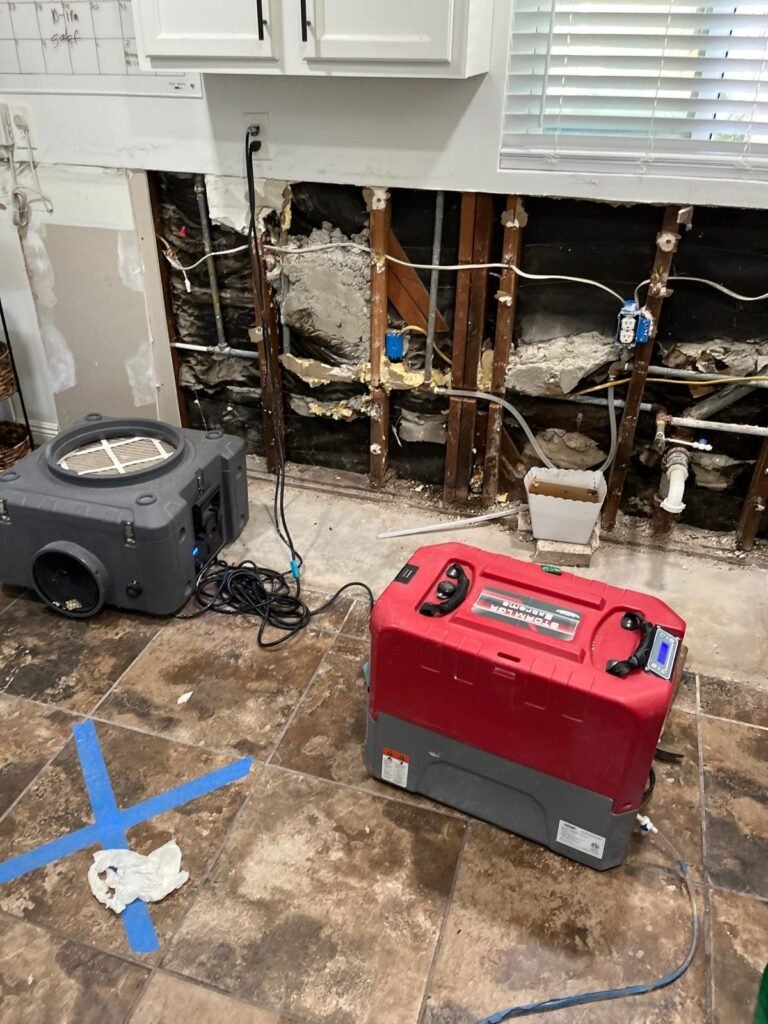
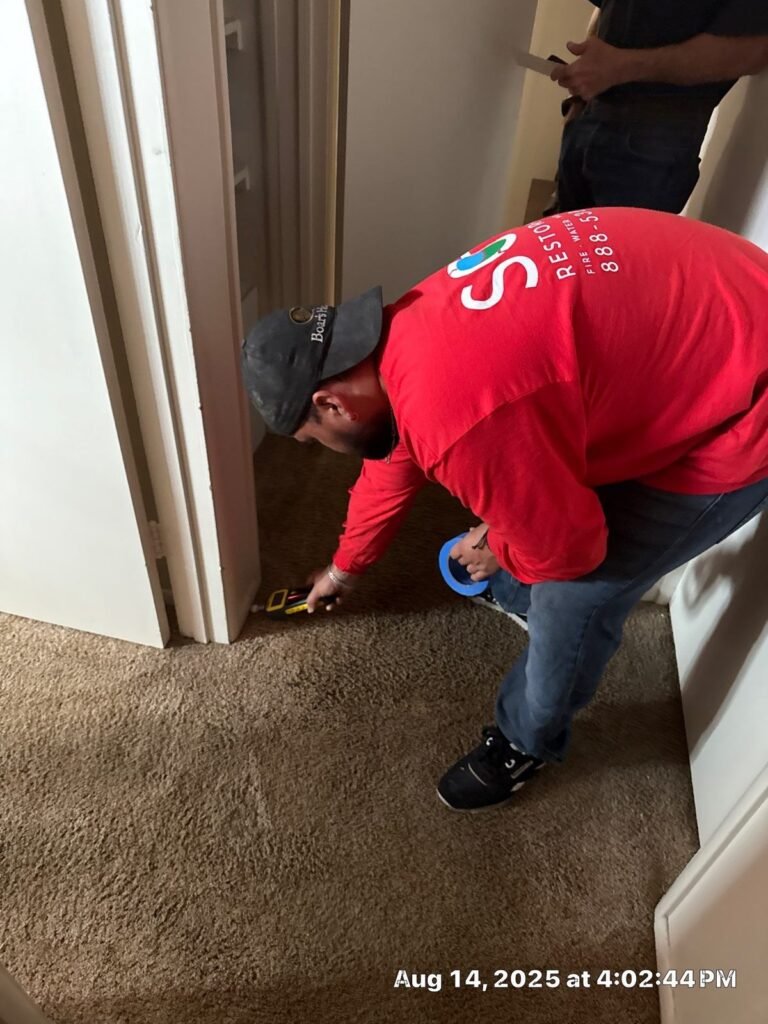

A room where the boxes sit two inches off the slab and nobody notices it any more: that is the target.