
A 1968 house sits under two rules at once. The asbestos presumption reaching back through 1980, and the federal lead paint rule reaching back through 1978. In Ventura County both apply before a stud is exposed, and neither one waits.
Yes, by more than a decade on both counts.
The asbestos line in California construction work is 1980 and the federal lead line is 1978.
A place finished in 1968 sits well behind both. The question was answered before anyone looked at your ceiling.
This is not a rare situation here. About 166,000 of the county’s roughly 295,000 housing units went up before 1980.
Enormously, which is why a blanket sentence is useless.
The median home in Ojai was built in 1971, and three of every four predate 1980.
In Santa Paula the median year is 1970, and one home in ten dates to 1939 or earlier.
That is nearly three times the county share. In Fillmore, one home in eight was standing before 1940.
Balloon framing, a raised foundation over a crawlspace, plaster on wood lath. Moorpark runs the other way, with four in five built after 1980.
The year on the assessor record. It sets the order.
Everything downstream of that answer changes with it.
A crew that opens a wall before checking it is guessing with your house.
The law made the assumption and handed you the disproving.
Cal/OSHA keeps that presumption in Title 8 section 1529. Two families of material get it automatically in any structure raised no later than 1980.
One is the lagging on a thermal system, the wrap around pipes, boilers and ducts.
The other is surfacing material, anything sprayed or troweled onto a surface. In a house of this vintage that nearly always means acoustic ceiling texture.
Two ways, and both of them end in paper.
A full inspection under the federal schools law, showing the material is not asbestos. Its inspector training became the national standard.
Or testing through an inspector holding that accreditation, or an industrial hygienist carrying the board credential for measuring workplace exposure.
What does not beat it: experience, a glance, a knuckle test, or a crew that has opened a hundred ceilings.
Four, and the last one catches people out.
Sweeping up after somebody else is regulated work.
The caution comes from the exposure ceiling. A tenth of a fiber per cubic centimeter averaged across eight hours.
And one fiber per cubic centimeter across any thirty minutes. A dry cut through textured ceiling can blow past that second number in minutes.
The county air district, and most sites get this wrong.
California has thirty-five air districts. The large one to the east covers four counties, and this is not one of them.
Its asbestos rule, the one quoted in most of the material online, carries no weight here.
What governs is local Rule 62.7, adopted in 1992 and never amended.
It reaches further, and its trigger is lower.
Rule 62.7 stands in place of the federal air standard inside this county.
The district says it covers all renovation and demolition operations, including ones the federal standard never regulated. And that it covers dwelling units.
Houses are in. The federal numbers people quote from memory belong to a standard that does not run here.
A contractor working off them is out of compliance the moment the saw starts.
A hundred square feet on renovation. One on demolition.
The renovation trigger is 100 square feet or more of asbestos containing material. Each planned operation gets its own notice.
For a demolition there is no trigger. Any quantity present, down to a single square foot, and the notice goes in.
That one difference reorganizes a lot of jobs.
It also explains why a fire loss heading toward demolition brings the district in, even when little suspect material survived.
Timing splits by building type, and a house is easier.
A residential notice has to be typed and in the district’s hands before work begins.
No waiting period and no district fee for buildings of four units or fewer.
Anything non-residential has to be postmarked or delivered no later than ten working days ahead.
Two calendar weeks off a commercial schedule if it goes in late. Nothing off a house.
They are what actually bite, because quantities climb.
When the quantity of asbestos changes by more than twenty percent, the notice has to be updated.
It almost always climbs once framing is exposed.
A delayed start takes five working days of notice. A delayed finish takes two, before the original completion date.
Above a hundred square feet of friable material.
Friable means crumbly enough to release fibers under hand pressure.
That work happens inside negative pressure containment, a sealed room kept at lower air pressure so fibers cannot drift outward.
Or inside a glove bag, unless the Air Pollution Control Officer approves another method in writing.
Ninety-nine square feet and a hundred and one are two different jobs. That is why the survey comes before the scope.
A laboratory, and nobody else. That includes us.
The cutoff the district uses is one percent. One sample above it makes the entire material asbestos containing.
Not only the piece that went into the jar. One result condemns the whole ceiling, or the whole floor.
Two numbers get confused constantly, so keep them apart.
One percent is the air district definition. Cal/OSHA registration for the contractor begins above a tenth of a percent, combined with 100 square feet of surface.
Yes. No survey, no demolition permit.
The district states that a building or home must be surveyed to obtain one.
Removal beforehand belongs to a contractor holding the C-22 classification, the state category covering asbestos abatement and nothing else.
Sampling is not a favor to an insurer or an optional line item.
The one exemption reads literally. It covers a single-unit dwelling where the owner and occupant does the work personally. It disappears the moment anyone gets paid.
Different year, different agency, different trigger.
The federal repair and painting rule governs renovations performed for compensation in housing built before 1978.
Plus facilities where young children spend regular time. Two words carry the whole thing: for compensation.
An owner repainting a hallway is outside it. Anyone paid to be in the room is inside it.
Six square feet a room indoors, twenty outdoors.
Damage work clears that before the first coffee break.
The footage also accumulates, so separate visits to the same room inside thirty days get added together.
And the exemption never applies to window replacement or to demolition, whatever the footage says.
Pulling one window out of a 1968 house puts the full rule in play.
Three, and all three end in paper.
The cutoff is identical in all three. One milligram per square centimeter, or half a percent by weight.
The two-year gap between the rules is what trips crews. A house finished in 1979 answers to the asbestos presumption and not to the lead rule.
The building changes, and so does the permit counter.
Manufactured housing is a larger share of this county than people assume. Federal code governs these units, not state building standards.
A steel chassis carries the floor, a plastic belly wrap runs underneath, and fiber insulation fills the cavity.
Water from above drains down and pools in that belly wrap, which holds it instead of letting it go.
A meter on the floor surface can read fine while the underside stays wet for weeks.
The state, not city hall, inside a mobilehome park.
Authority over alterations and repairs there sits with the state housing department under Health and Safety Code section 18300.
Local ordinances are preempted. A city takes that authority only after thirty days of written notice and approval.
Which counter you walk up to depends on where the home sits, not on what broke.
Manufactured homes are about one in ten in Santa Paula and close to that in Fillmore. Countywide it is roughly one in twenty-five.
A folder stays in the house, and every page has an owner.
That folder is what an insurance company actually reads, and what a buyer’s inspector will ask for years from now.
The crew that metered the walls is the crew that frames, tapes, textures and paints. The rebuild work never changes hands.
It carries CSLB #1131134, and the mitigation half carries IICRC #70194273. Look both up.
Three, and each carries somebody else’s signature.
The lab result comes on a laboratory’s letterhead, with a percentage beside each sample that belongs to them.
We pick the spot, log the room and material, and ship the jar. A ceiling that never went into a jar has no percentage.
The folder calls that one untested, and the permit card fills with initials that are not ours.
Past putting the house back as it was, the sizes arrive on a sealed sheet. An engineer nobody here employs draws it.
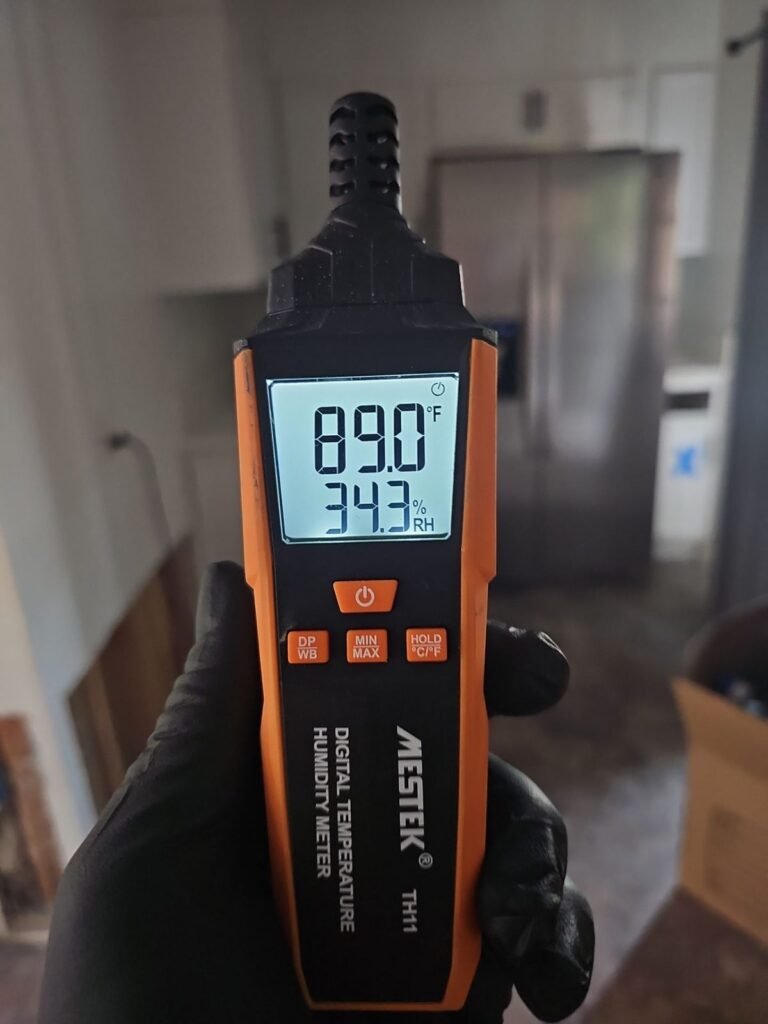
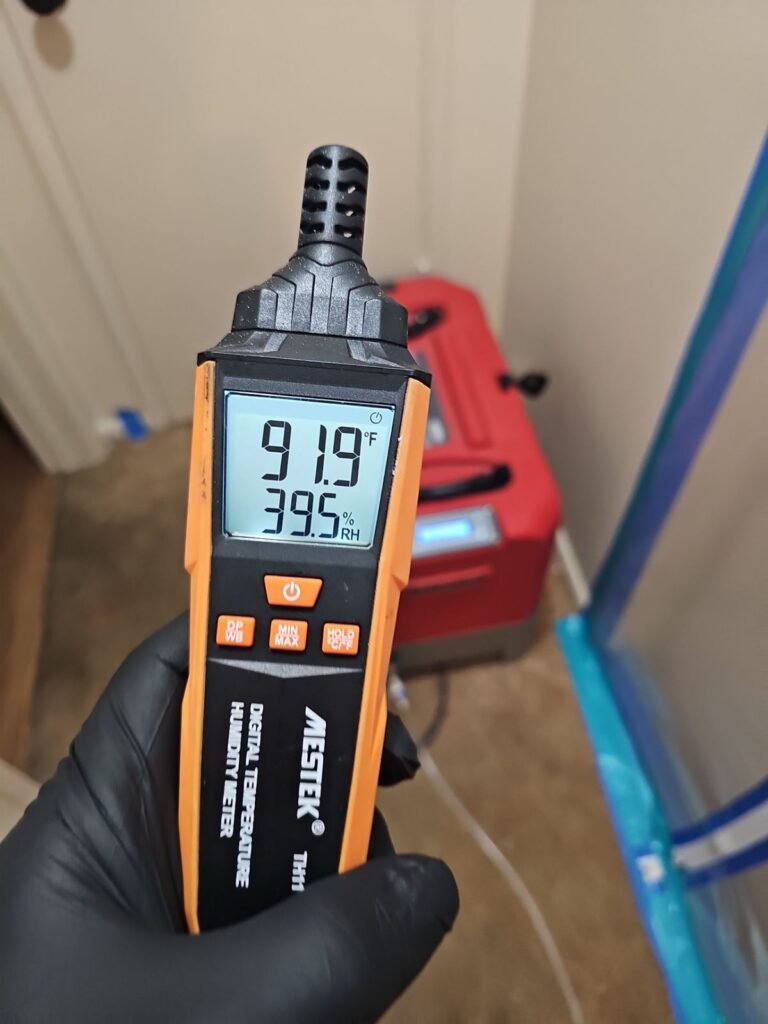
Dated photographs, the readings, and the notice that went in.
Room by room, with the copy of what the district received.
A buyer’s inspector will want the lab page most of all.
The rest of what an old house raises is in the guides.
In the folder you want a laboratory page with a percentage on it, not a blank where somebody guessed.