
Rebuilding after a loss in Ventura County runs through eleven permit counters. The ten cities, plus the county for the ground in between. Six of the ten publish how long a first plan check takes. Four publish nothing at all.
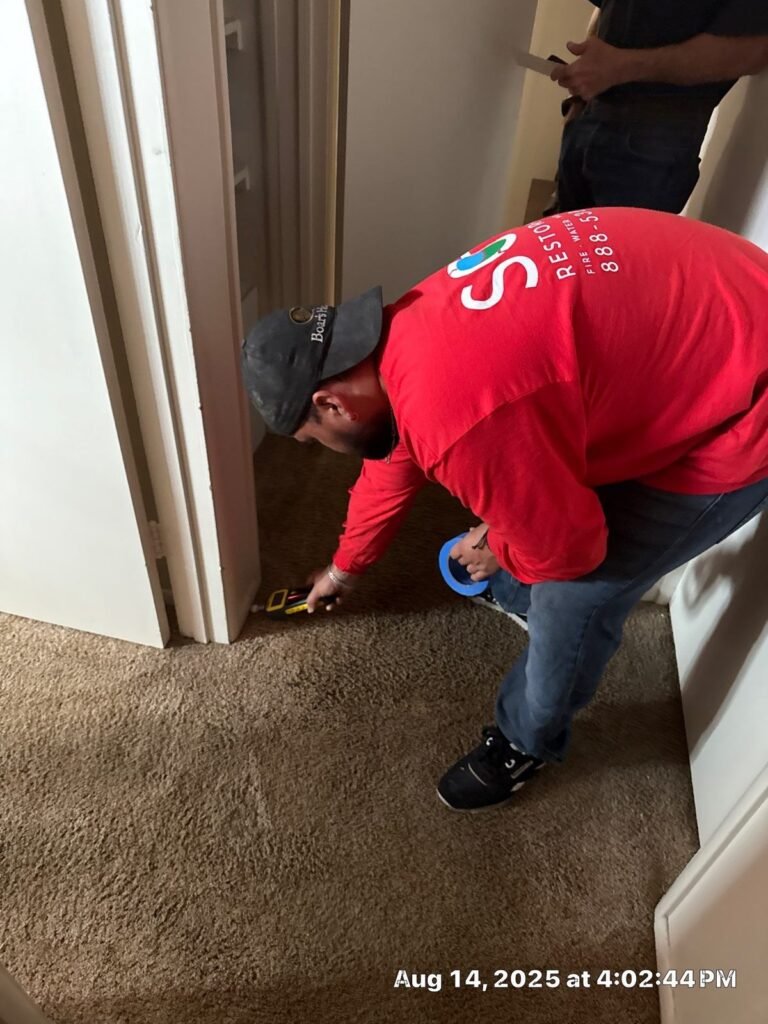
No. Replacing what the water ruined normally needs a permit.
In the unincorporated county the exemption list lives in Section 105.2 of the building code. Seventeen items sit on it.
Not one mentions drywall or a reroof. The closest is item eight, covering painting, papering, tiling, carpeting, cabinets and countertops.
It carries no square footage. That difference matters more than it looks.
Paint is finish. A sheet of board screwed to a stud is part of an assembly, and assemblies are what a code governs.
Two of the ten cities publish a figure, both in square feet.
Oxnard puts interior patching at fifty square feet, so long as the wall is not part of a fire-resistive assembly.
In an ordinary house that means the garage separation or a wall a duplex shares. The city of Ventura draws its line under a hundred square feet.
The catch is where those numbers live. Both come off counter handouts rather than an adopted ordinance.
That makes them administrative practice, not a right you hold. Treat them as practice and never schedule around them.
Nothing, and silence is not permission.
The other eight publish no drywall figure whatsoever. Silence means you ask before the saw comes out.
One piece of folklore worth burying: the ten square yards allowance repeated in contractor forums appears in no code here.
The stretch between applying and being issued. Not an inspection.
Nobody visits the house. A plans examiner sits with your drawings, reads them against the code, and sends back corrections.
You answer the list, resubmit, and wait again. Only when that list comes back empty does a permit exist.
Repair-in-kind drawings are thin, so this stage can be short. It stretches the moment the rebuild changes the assembly.
A wall that moves, a header that gets longer, a roof line that is not the one that burned.
Sometimes a private firm with clients in other towns.
Camarillo stopped accepting paper plans, so the submittal moves through its online portal.
Its building and safety function is contracted out. Moorpark uses the same firm, and Fillmore contracts out both inspection and plan review to a different one.
None of the three hands the work to the county. So the city reading your drawings may employ nobody who does it.
Your queue belongs to a company, not to a town.
Where a city publishes a figure, this is the figure.
Oxnard also quotes an express track at two to four weeks.
Camarillo, Thousand Oaks, Fillmore and Ojai publish no plan check time at all.
Which tells you how much weight a promised date deserves in those four.
No. Twenty business days is a full month on a calendar.
The count usually starts when a submittal is accepted as complete, not on the evening you uploaded it.
Read the unit before you read the number.
Every figure above describes a first review, not an approval.
Corrections come back. You fix them, you resubmit, and a second clock starts that can run as long as the first.
Two rounds on a rebuild is ordinary. Where a city publishes nothing, a contractor quoting you weeks is quoting a guess.
We would rather tell you what got filed, on what date, and which counter is holding it. All three are checkable.
What an examiner will write is not.
Two, and both are narrower than they sound.
The same-day counter review in Moorpark covers commercial tenant improvements, not houses.
The one-business-day issuance in Oxnard needs an outside professional signing the plans with a peer review behind them.
It is also why a rebuild arrives as a single signed figure instead of an hourly tally. The rebuild cost page takes that apart.
The asbestos notice, and the local rule is its own.
The air district here is not the South Coast one, and its rule is 62.7, adopted in 1992.
Checklists written for that other basin cite a different rule, with different thresholds and a different waiting period.
They also cover no houses at all. Rule 62.7 covers dwellings, and the federal standard it stands in for does not.
That gap is exactly where an out-of-area crew falls in.
A hundred square feet on a renovation, any amount on a demolition.
A renovation disturbing a hundred square feet or more of asbestos-containing material needs a written notice.
A demolition needs one where any amount at all is present. Any amount means one square foot.
The timing splits by building type. A residential notice has to be typed and received before work begins.
No waiting period and no fee on buildings of four units or fewer. Anything non-residential goes in ten working days ahead.
Revisions, slipped dates, and one sample above one percent.
If the quantity differs by more than twenty percent from what you noticed, the notice gets revised.
A slipped start wants five working days of warning. A slipped finish wants two, before the original completion date.
The laboratory cut is unforgiving. One sample above one percent classifies the whole material, not only the piece sampled.
More than half this county’s housing predates 1980.
Cal/OSHA presumes asbestos in thermal system insulation and in sprayed or troweled surfacing in anything built no later than 1980.
The spread by city is enormous. Roughly three of every four homes in Ojai fall inside the presumption.
Against about one in five in Moorpark.
Several cities meter it as a percentage across twelve months.
Crossing that line upgrades the entire roof instead of the patch. Ojai is the sharpest version in the county.
Repair more than ten percent of the roof area in one year. The whole roof then has to finish as Class A.
Class A is the top fire rating a roof covering can carry. Reaching it means stripping every existing layer down to the deck.
Repair eleven percent and you have just bought a hundred.
Each their own way, and none of them match.
Port Hueneme runs the order backwards from everywhere else.
Any reroof, partial or total, and any alteration to an existing surface, needs a compliance inspection before the permit issues.
Before, not after. Put it in the schedule or the schedule is fiction.
Here, yes, and the difference is on the record.
The Mountain Fire came out of Somis. It destroyed 243 structures and damaged another 126.
Afterward the county removed a step. Zoning clearance was eliminated for fire rebuilds, so those applications land at the building counter directly.
Four dedicated planners were assigned to a rebuild team. The Board of Supervisors waived permit fees for owners who held the property on the day.
Somebody who bought afterward does not inherit that waiver.
No. What people remember closed a long time ago.
The local assistance center ran for nine days and then shut.
Anyone sending you to walk plans in there is describing a door locked for well over a year.
For honest scale, take the county’s own update. Seventeen months from the fire to one family moving back in.
On a track with waived fees and dedicated planners behind it. Anybody selling you a season is selling.
Fillmore, where a fire-damage inspection is written law.
Its own code carries an inspection after a fire that damaged structural, plumbing, electrical or mechanical systems.
Elsewhere that step is good practice. There it is required.
The numbers are ours. The opinions belong elsewhere.
The house gets closed by the crew that opened it. Framing, insulation, board, texture, paint, trim and floor.
That runs under CSLB #1131134, with IICRC #70194273 on the mitigation half. We file, answer the correction list, and stand there for every inspection.
What you keep afterward is numbers anybody can check. Application date, permit number, square feet of material out of each room.
A small patch below the exempt line.
An owner may pull their own permit in every city here. We file when plan check is in play. That is where one wrong sheet costs weeks.
The examiner’s, the inspector’s, and the engineer’s.
A plans examiner decides what goes on the correction list. Two of them reading one drawing do not always write the same list.
An inspector decides on the day whether the work matches what was approved. Being right does not make that call ours.
Past putting the room back, the sizing comes off a structural engineer’s drawing.
The loss has a measurable edge. What you have been meaning to change sits outside it, on its own paper, with the other guides.



Call and the nearest crew will walk the house, say what needs a permit and what does not, and put the schedule in writing rather than in the air.